Species details
Deadly dapperling
Lepiota brunneoincarnata
Deadly poisonous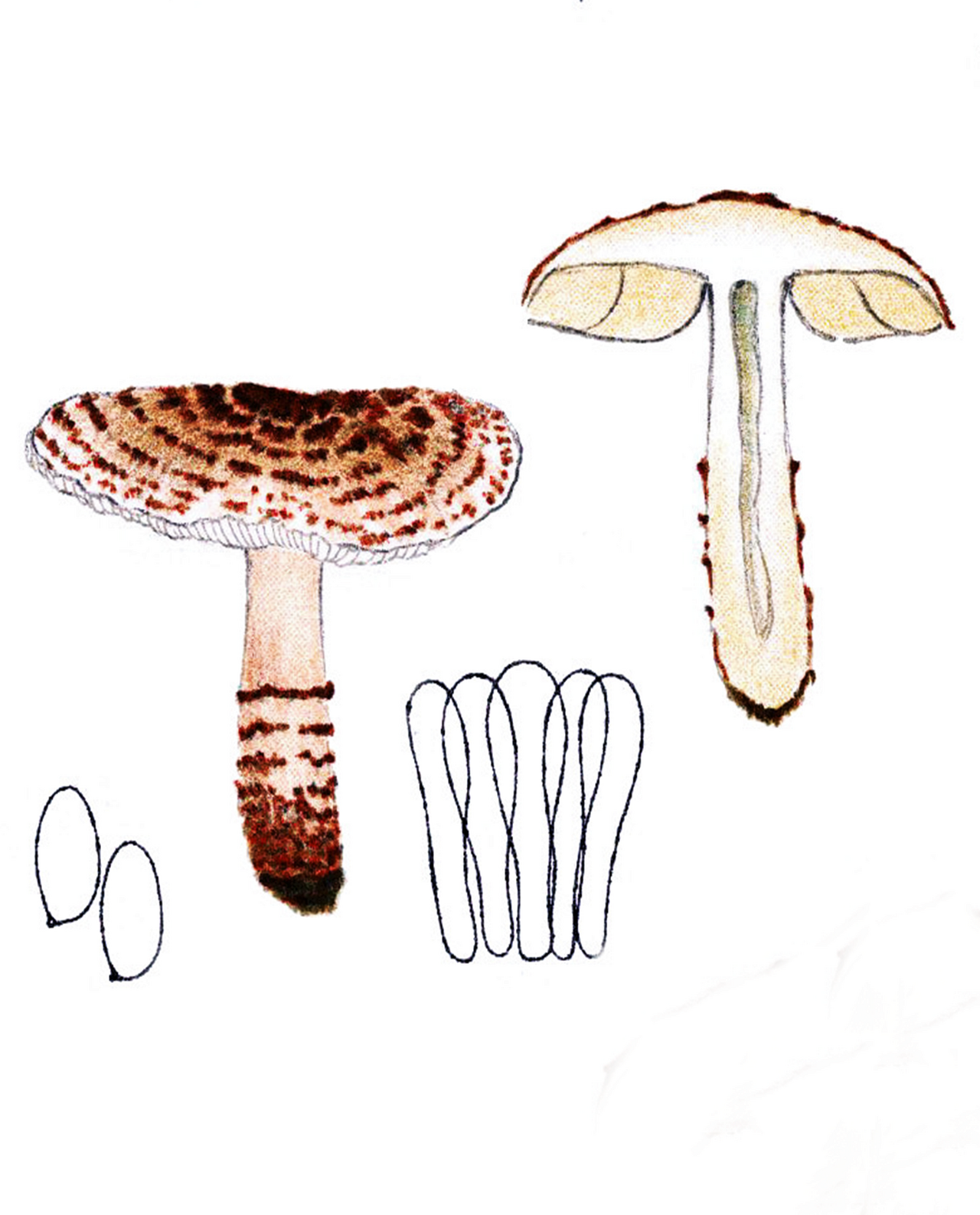
Photo: User:Strobilomyces · CC BY-SA 3.0 · Photo source · License

Description
A small deadly dapperling with brown scales on a flesh-pink cap and an indistinct ring.
Identification features
Gills are white, the stem below the ring is brownish-scaly, and it contains amatoxins.
Identification checklist
Check the entire fruitbody for identification. A small deadly dapperling with brown scales on a flesh-pink cap and an indistinct ring. Gills are white, the stem below the ring is brownish-scaly, and it contains amatoxins. Typical habitat: Lawns, parks, gardens, path edges, and open woodland, often in warm urban habitats.
Detailed features
- Cap
- 2–4(6) cm, flesh- to reddish-brown, initially rounded, later convex to flat; dry with dense reddish-brown scales, especially centrally.
- Hymenophore
- Gills initially white, later yellowish to faintly flesh-toned, broad and free from the stem.
- Stem
- 2.5–5 × 0.5–1 cm, white above the veil remnant, reddish-brown and scaly below; the ring is delicate and may disappear quickly.
- Flesh
- White, sometimes turning pinkish on exposure.
- Smell
- May be faintly fruity.
- Taste
- Do not taste.
- Spore print
- White.
Size
- Cap diameter
- 2–6 cm
- Stem height
- 2,5–5 cm
- Stem diameter
- 0,5–1 cm
Habitat
Lawns, parks, gardens, path edges, and open woodland, often in warm urban habitats.
Fruiting period
July, August, September, October
Ecology
- Trophic mode
- Saprotrophic
- Substrate
- Grassland, Soil
- Notes
- Grows among grass at woodland edges, in parks and similar habitats under trees; fruits in autumn.
How to separate similar species
Compare especially with these similar species: Lepiota subincarnata, Lepiota helveola, Macrolepiota procera. Check the combination of cap shape and colour, spore-bearing surface, stem, flesh changes and habitat. A single feature or photograph is not enough; if the key characters do not match the description, do not treat the identification as confirmed.
Similar species
- Parasol mushroom (Macrolepiota procera)
The parasol is much larger, with a snakeskin-patterned stem and a large movable ring.
- Lepiota helveola DANGEROUS
A very similar small species; because of amatoxin risk, small Lepiota should never be judged edible from a photo alone.