Species details
Contrary webcap
Cortinarius varius
Extra caution required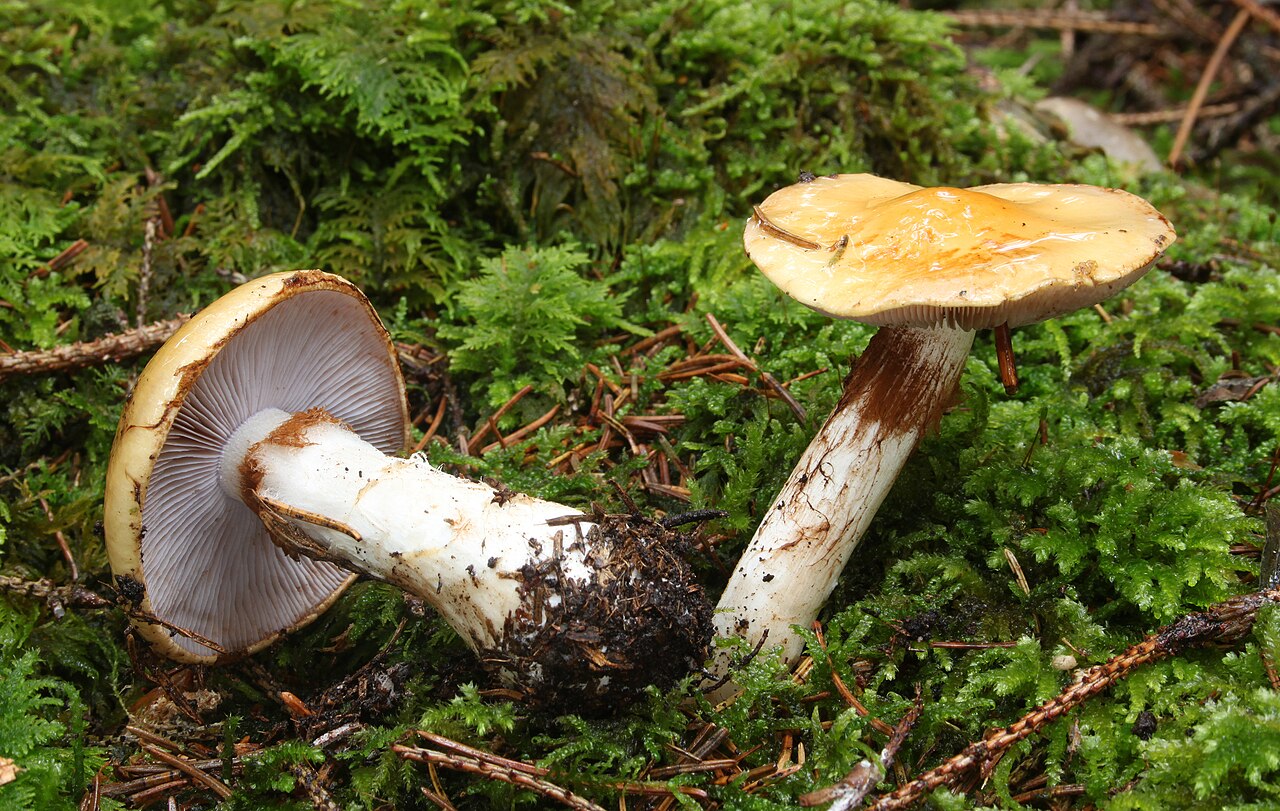
Photo: Holger Krisp · CC BY 3.0 · Photo source · License

Description
A robust webcap with an orange to brick-yellow sticky cap, lilac young gills and a stout pale stem.
Identification features
Gills start blue-lilac and become ochre-cinnamon. The firm stem is club-shaped and may be bluish near the top. The spore print is rusty brown.
Identification checklist
Check the orange-yellow sticky cap, lilac young gills, robust club-shaped pale stem and rusty-brown spore print. The characteristic lilac gill colour disappears in older specimens.
Detailed features
- Cap
- A robust webcap with an orange to brick-yellow sticky cap, violet young gills and a stout pale stem.
- Hymenophore
- Gills start blue-lilac and become ochre-cinnamon. The spore print is rusty brown.
- Stem
- The firm stem is club-shaped and may be bluish near the top.
- Flesh
- Pale, sometimes bluish to yellowish in the stem.
- Smell
- No distinctive smell.
- Spore print
- Rust-brown.
Habitat
Mycorrhizal mainly in coniferous woodland, often on calcareous soils; late summer to late autumn.
Fruiting period
August, September, October, November
Ecology
- Trophic mode
- Mycorrhizal
- Host trees
- Spruce (Picea), Pine (Pinus)
- Substrate
- Forest soil
- Soil
- Calcareous
- Notes
- Mycorrhizal species. Mycorrhizal mainly in coniferous woodland, often on calcareous soils; late summer to late autumn.
How to separate similar species
Similar webcaps may show stronger radial fibres and different blue-green tones. Reliable identification is difficult because many Cortinarius species look alike.
Similar species
Interesting facts
Did you know? The blue-lilac young gills become cinnamon to rusty-brown as the spores mature.