Species details
Bruising webcap
Thaxterogaster purpurascens
Extra caution required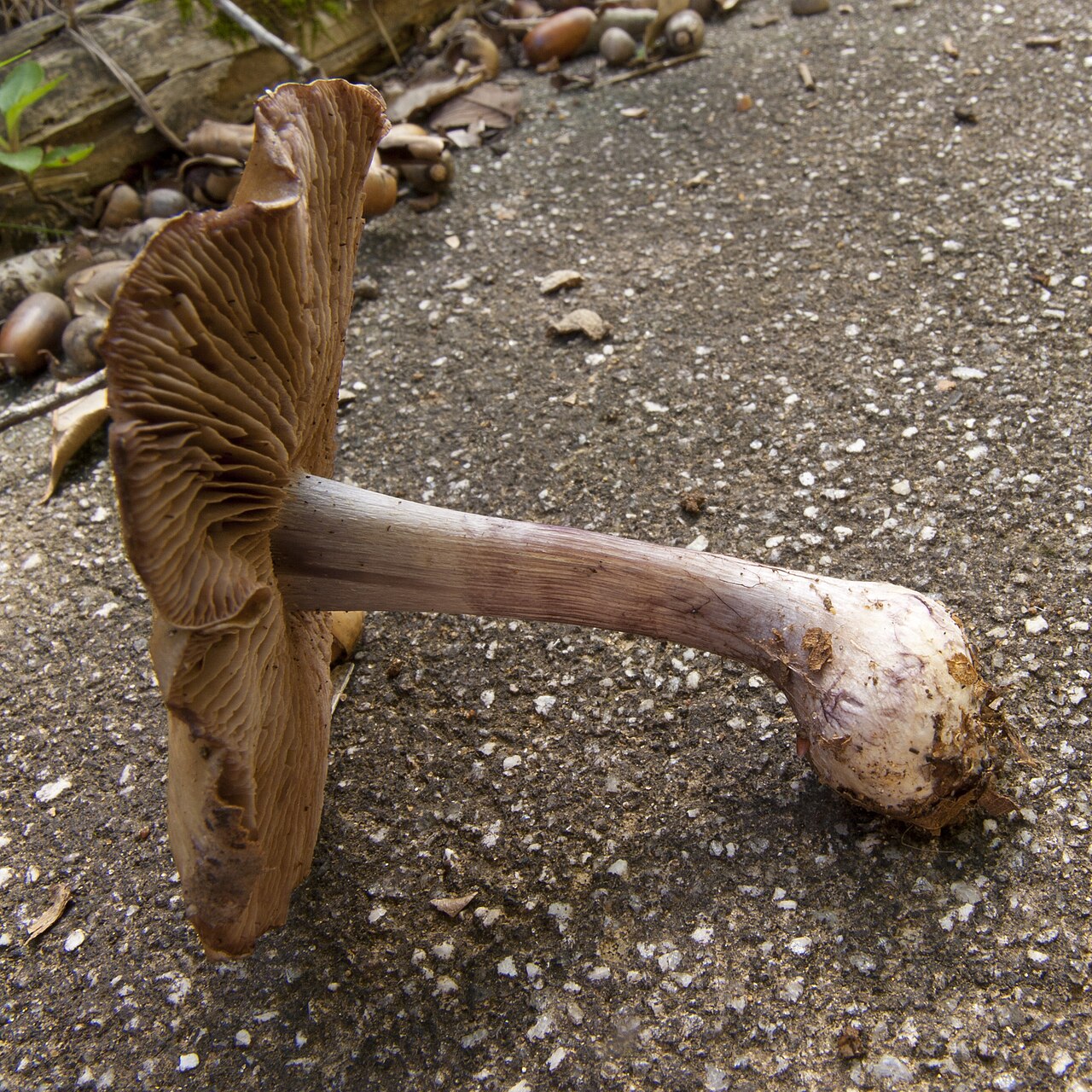
Photo: Σ64 · CC BY 3.0 · Photo source · License

Description
A fleshy brownish to grey-blue webcap relative with violet gills and stem that characteristically bruises purple.
Identification features
The cap is sticky when wet and very variable in colour. Young gills are dark violet, later violet-brown. The stem has a distinctly enlarged, bulbous base.
Identification checklist
The most important feature is purple-violet bruising of gills, flesh and stem when pressed or cut. Also check the sticky cap and strongly enlarged base.
Detailed features
- Cap
- A fleshy brownish to grey-blue webcap relative with violet gills and a stem that characteristically turns purplish when pressed.
- Hymenophore
- Young gills are dark violet, later violet-brown.
- Stem
- The stem has a distinctly enlarged, bulbous base.
- Flesh
- Pale violet and firm, slowly turning purplish-red when pressed or cut.
- Smell
- No distinctive smell.
- Spore print
- Rust-brown.
Size
- Cap diameter
- 5–10 cm
- Stem height
- 4–8 cm
- Stem diameter
- 1–2 cm
Habitat
Mycorrhizal mainly in coniferous woodland with spruce, often on acidic soils; in autumn.
Fruiting period
September, October, November
Ecology
- Trophic mode
- Mycorrhizal
- Host trees
- Spruce (Picea)
- Substrate
- Forest soil
- Soil
- Acidic
- Notes
- Mycorrhizal species. Mycorrhizal mainly in coniferous woodland with spruce, often on acidic soils; in autumn.
How to separate similar species
Similar violet webcaps differ in base shape, flesh reaction and cap colours. Older specimens may lose much of the violet colour and become harder to identify.
Similar species
- Thaxterogaster porphyropus
- Blue-foot webcap (Cortinarius glaucopus)
- Cortinarius cyanites
Interesting facts
Did you know? Gills, stem and flesh can slowly develop a striking purplish-red colour when bruised.