Species details
Blue-foot webcap
Cortinarius glaucopus
Extra caution required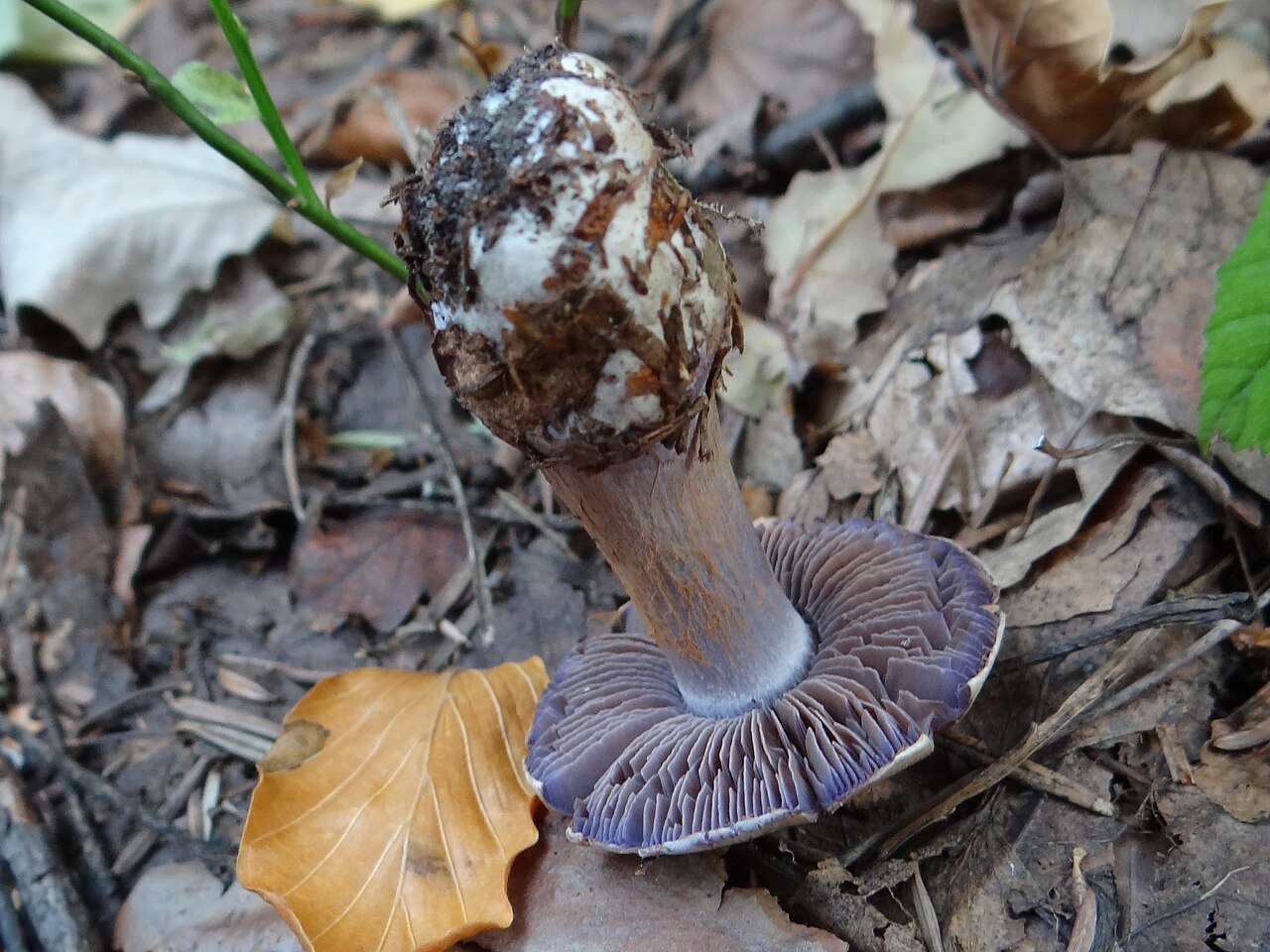
Photo: Jerzy Opioła · CC BY-SA 4.0 · Photo source · License
.jpg)
Description
A robust webcap with a brown to olive fibrillose cap, bluish young gills and a blue-violet upper stem with an enlarged base.
Identification features
The cap may be slimy when wet and shows strong radial fibres as it dries. Gills change from bluish to brown. The stem has a marginate bulbous base and the spore print is rusty brown.
Identification checklist
Check the radially fibrillose brown-olive cap, bluish young gills, blue-violet upper stem and marginate bulbous base. Mature specimens lose much of the blue colour.
Detailed features
- Cap
- A robust webcap with a brown to olive fibrous cap, bluish young gills and a blue-violet upper stem with a swollen base.
- Hymenophore
- Gills change from bluish to brown. The stem has a marginate bulbous base and the spore print is rusty brown.
- Stem
- The stem has a marginate bulbous base and the spore print is rusty brown.
- Flesh
- White in the cap, sometimes bluish in the upper stem and yellowish to brownish lower down.
- Smell
- No distinctive smell.
- Spore print
- Rust-brown.
Size
- Cap diameter
- 5–10 cm
- Stem height
- 4–9 cm
- Stem diameter
- 0,8–2 cm
Habitat
Mainly in coniferous woodland with spruce, less often hardwoods; often in groups or rings, summer and autumn.
Fruiting period
July, August, September, October, November
Ecology
- Trophic mode
- Mycorrhizal
- Host trees
- Spruce (Picea)
- Substrate
- Forest soil
- Notes
- Mycorrhizal species. Mainly in coniferous woodland with spruce, less often hardwoods; often in groups or rings, summer and autumn.
How to separate similar species
C. varius usually has a more uniformly orange-yellow cap and different stem form. T. purpurascens characteristically bruises purple. Always combine several characters.
Similar species
Interesting facts
Did you know? The species often grows in groups or rings, a feature reflected in its Slovenian name.