Species details
Bearded Amanita
Amanita ovoidea
Extra caution required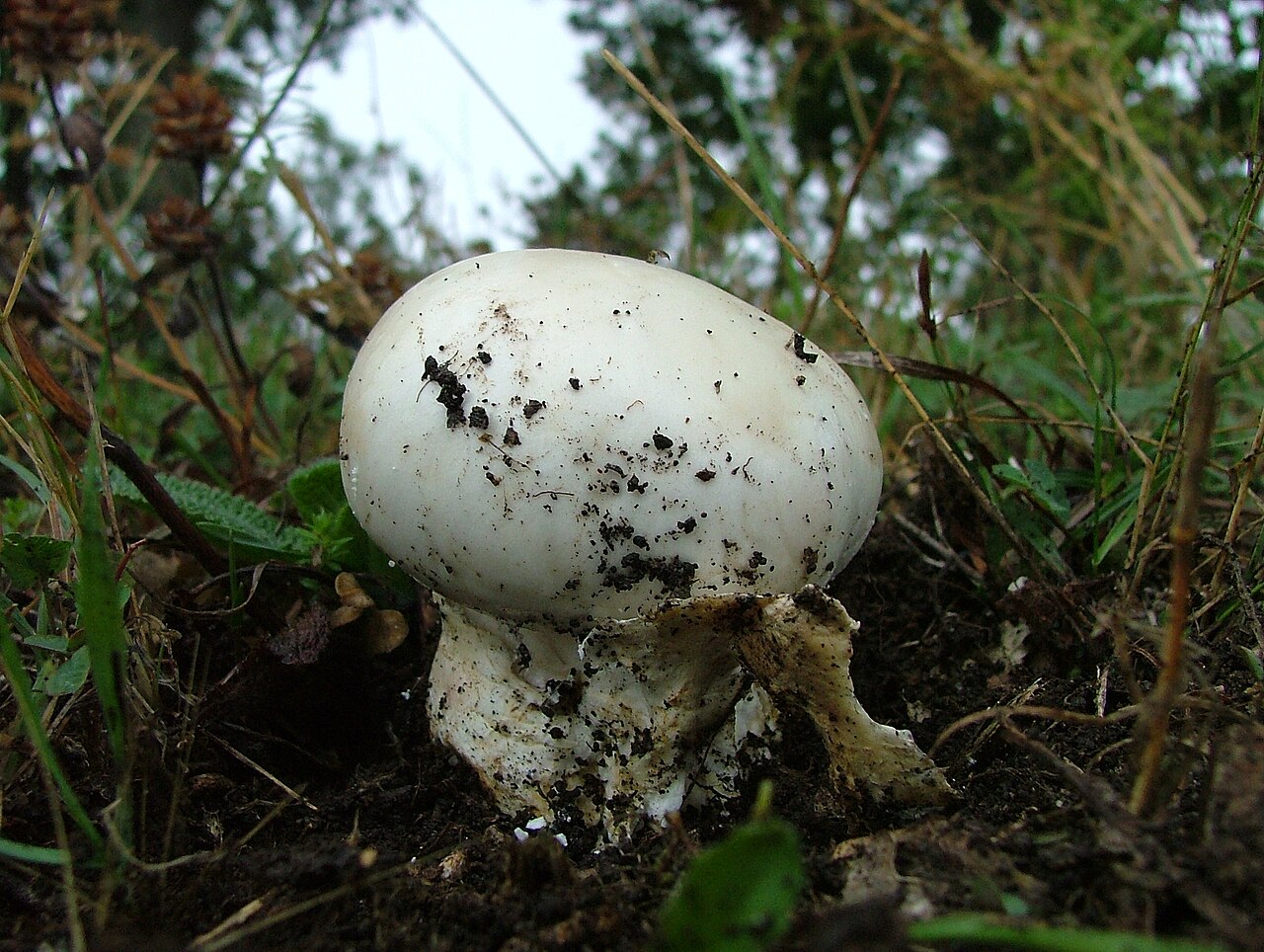
Photo: Rocco Stasi · CC BY 3.0 · Photo source · License

Description
A very large white Amanita with a fleshy cap, stout stem and thick sack-like volva.
Identification features
The cap margin is often shaggy and the ring soft and fleeting; deadly white Amanitas are dangerous lookalikes.
Identification checklist
Check the entire fruitbody for identification. A very large white Amanita with a fleshy cap, stout stem and thick sack-like volva. The cap margin is often shaggy and the ring soft and fleeting; deadly white Amanitas are dangerous lookalikes. Typical habitat: Warm calcareous sites in deciduous woodland and Mediterranean scrub.
Detailed features
- Cap
- 6–18 cm, very fleshy, initially hemispherical then convex, white to straw-yellow; veil remnants may remain at the margin.
- Hymenophore
- Gills white, crowded and robust.
- Stem
- 6–18 × 1.5–3 cm, white and floccose, with a large thick sac-like volva; the ring is soft and often ephemeral.
- Flesh
- White and firm.
- Smell
- Strong, sometimes unpleasant, faintly radish- or mushroom-like.
- Spore print
- White.
Size
- Cap diameter
- 6–18 cm
- Stem height
- 6–18 cm
- Stem diameter
- 1,5–3 cm
Habitat
Warm calcareous sites in deciduous woodland and Mediterranean scrub.
Fruiting period
June, July, August, September, October, November
Ecology
- Trophic mode
- Mycorrhizal
- Host trees
- Oak (Quercus)
- Substrate
- Forest soil
- Soil
- Calcareous
- Notes
- A warmth-loving Mediterranean species of calcareous habitats, especially open oak and mixed woodland.
How to separate similar species
Compare especially with these similar species: Amanita strobiliformis, Amanita verna, Amanita virosa. Check the combination of cap shape and colour, spore-bearing surface, stem, flesh changes and habitat. A single feature or photograph is not enough; if the key characters do not match the description, do not treat the identification as confirmed.
Similar species
- Warted Amanita (Amanita strobiliformis)
Amanita strobiliformis has larger thick cap scales and a more adherent, less sac-like volva.
- Destroying angel (Amanita verna) DANGEROUS
Spring destroying angel is deadly and usually more slender; with white amanitas the volva, ring and entire fruitbody must be checked.
Conservation
- Red list
- R – rare species
- Notes
- On the Slovenian Red List: R – rare species.
Interesting facts
Did you know? The species is distinctly Mediterranean and warmth-loving and in Slovenia is mainly associated with warmer coastal regions.