Species details
Annosum root rot
Heterobasidion annosum
Inedible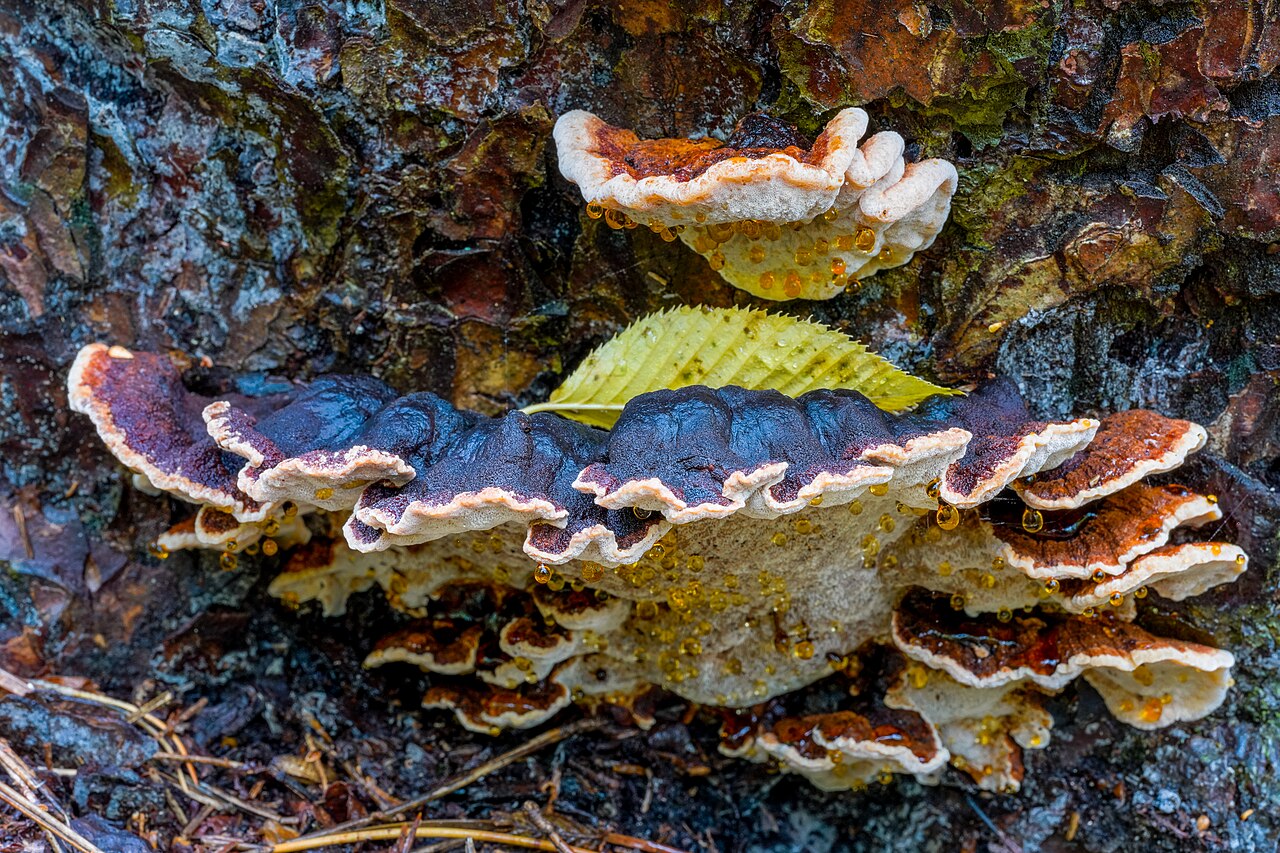
Photo: Matej Frančeškin · CC BY 4.0 · Photo source · License

Description
A hard perennial bracket fungus on roots and stem bases of conifers, with a brown to dark-brown upper surface, pale margin and white pore surface.
Identification features
The fruitbody is laterally attached and stemless, often irregular and lumpy. The margin may be broadly white; pores are small, round and initially white. Flesh is corky to woody and very tough.
Identification checklist
Check for growth directly from conifer roots or the stem base, a hard perennial bracket without a stem, brown upper surface with a pale margin and a finely pored white underside. Host tree is important.
Detailed features
- Cap
- A hard perennial bracket fungus on roots and trunk bases of conifers, with a brown to dark-brown upper surface, pale margin and white pore surface.
- Hymenophore
- The margin may be broadly white; pores are small, round and initially white.
- Stem
- The fruitbody is laterally attached and stemless, often irregular and knobbly in shape.
- Flesh
- Corky to woody and very tough.
- Smell
- No useful distinctive smell for field identification.
- Spore print
- White.
Habitat
Parasitic and saprotrophic on roots, stumps and stem bases of conifers, especially pines and other conifers; fruitbodies may persist year-round.
Fruiting period
January, February, March, April, May, June, July, August, September, October, November, December
Ecology
- Trophic mode
- Parasitic
- Host trees
- Pine (Pinus), Spruce (Picea), Fir (Abies)
- Substrate
- Roots, Stumps, Living wood, Dead wood
- Notes
- Primarily parasitic species that can continue growing on dead wood. Parasitic and saprotrophic on roots, stumps and stem bases of conifers, especially pines and other conifers; fruitbodies may persist year-round.
How to separate similar species
Ganoderma and other brackets can look similar but differ in form, cap surface, pores and host. With old fruitbodies, a photo without the underside and substrate is often insufficient.
Similar species
- Artist's conk (Ganoderma applanatum)
- Red-belted conk (Fomitopsis pinicola)
- Heterobasidion species
Interesting facts
Did you know? It causes white rot of conifer roots and stem bases and is an important forest pathogen.