Species details
Angel wings
Pleurocybella porrigens
Poisonous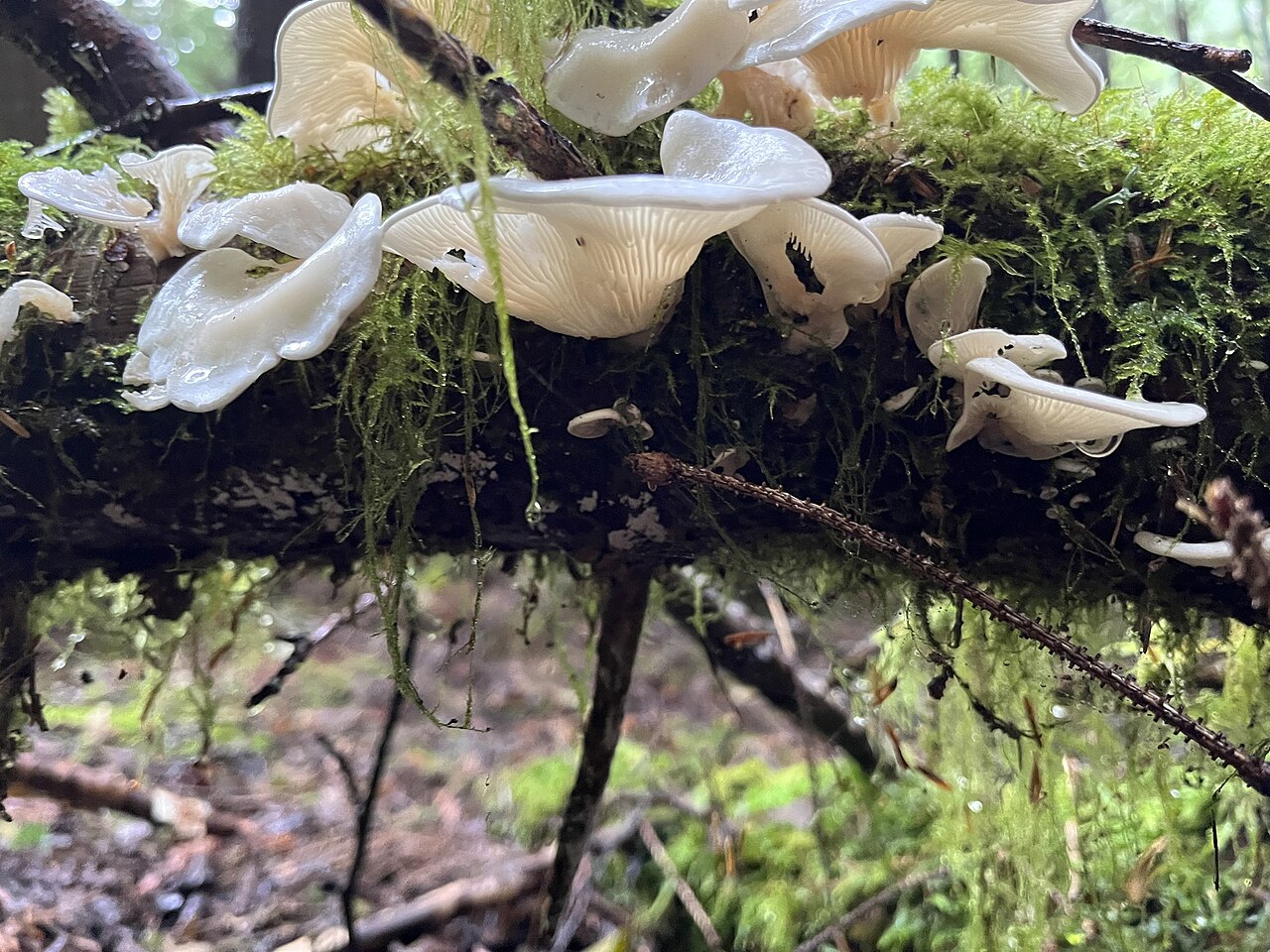
Photo: alexbarnard · CC BY 4.0 · Photo source · License

Description
A thin white shell-shaped mushroom without a stem, growing in overlapping clusters on conifer wood.
Identification features
Gills are white, crowded, and run to the attachment point; the flesh is very thin and fragile.
Identification checklist
Check the entire fruitbody for identification. A thin white shell-shaped mushroom without a stem, growing in overlapping clusters on conifer wood. Gills are white, crowded, and run to the attachment point; the flesh is very thin and fragile. Typical habitat: On heavily decayed conifer wood, especially fir and spruce, in moist woodland.
Detailed features
- Cap
- 3–8 cm, snow-white to cream, very thin, shell-, ear- or fan-shaped, laterally attached to wood; margin may be wavy.
- Hymenophore
- Gills white to pale yellowish, narrow and crowded, radiating toward the point of attachment.
- Stem
- A true stem is usually absent; the fruitbody is directly attached laterally to the substrate.
- Flesh
- Whitish, thin, pliable to tough.
- Smell
- Indistinct.
- Taste
- Do not taste.
- Spore print
- White.
Size
- Cap diameter
- 3–8 cm
Habitat
On heavily decayed conifer wood, especially fir and spruce, in moist woodland.
Fruiting period
August, September, October, November
Ecology
- Trophic mode
- Saprotrophic
- Substrate
- Dead wood, Stumps
- Notes
- Saprotrophic on dead conifer wood, especially decaying logs and stumps; often forms large clusters.
How to separate similar species
Compare especially with these similar species: Pleurotus pulmonarius, Crepidotus species, Phyllotopsis nidulans. Check the combination of cap shape and colour, spore-bearing surface, stem, flesh changes and habitat. A single feature or photograph is not enough; if the key characters do not match the description, do not treat the identification as confirmed.
Similar species
- Phoenix oyster (Pleurotus pulmonarius)
The phoenix oyster is usually more robust, often has a short stem, and grows mainly on hardwood.
- Phyllotopsis nidulans
Usually yellowish to orange and often more noticeably hairy or felted.