Species details
Yellow knight
Tricholoma equestre
Poisonous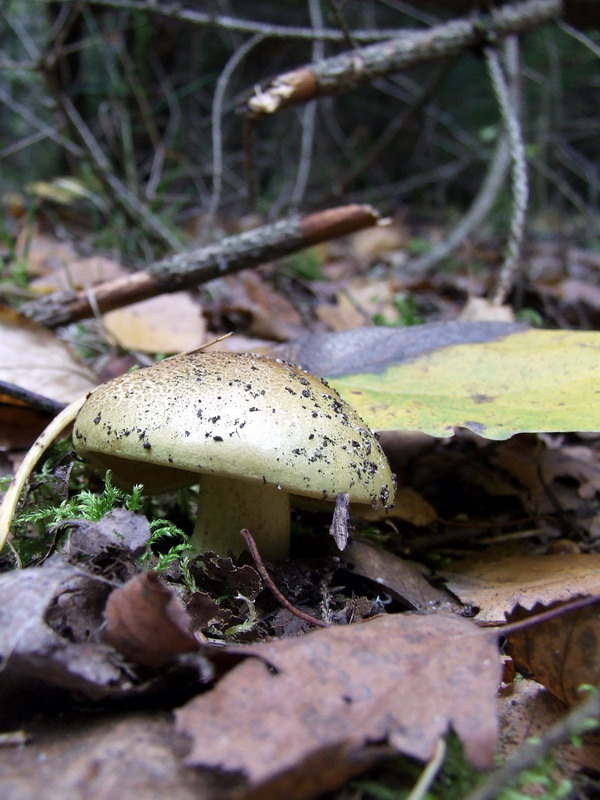
Photo: Tocekas · CC BY-SA 3.0 · Photo source · License

Description
A yellow-green tricholoma with yellow gills and no ring.
Identification features
The cap may be olive green and finely scaly toward the centre. The species has been associated with severe poisoning after repeated consumption and is listed here as toxic.
Identification checklist
The cap is yellow to olive-yellow with a brown-olive, fibrous or finely scaly centre. Gills and stem are yellow, there is no ring, and the spore print is white. It grows mainly with pine on sandy soils and has no strong odour.
Detailed features
- Cap
- 5–8 cm, yellow to olive-yellow, dry, with fine olive-brown to brown fibres or scales, especially toward the centre.
- Hymenophore
- Gills are bright sulphur-yellow, crowded and sinuate at the stem.
- Stem
- 5–10 × 0.5–1.2 cm, yellow, cylindrical, without ring or cortina.
- Flesh
- Whitish to yellowish and firm; often more yellow just beneath the surface.
- Smell
- Characteristically mealy.
- Spore print
- White.
Size
- Cap diameter
- 5–8 cm
- Stem height
- 5–10 cm
- Stem diameter
- 0,5–1,2 cm
Habitat
Mostly in sandy pine and other coniferous woodland.
Fruiting period
August, September, October, November
Ecology
- Trophic mode
- Mycorrhizal
- Host trees
- Pine (Pinus)
- Substrate
- Sandy soil
- Notes
- A mycorrhizal species, most often associated with pines on sandy soils and in conifer woodland.
Distribution
- Notes
- Distributed in Europe mainly in areas with pine and other conifer woodland.
How to separate similar species
Sulphur knight is more uniformly sulphur-yellow and has a strong unpleasant coal-gas or tar smell. Death cap has white gills, a ring, and a sac-like volva and must always be ruled out.
Similar species
- Sulphur knight (Tricholoma sulphureum) DANGEROUS
Sulphur knight has a distinctly unpleasant gas-like smell and a more uniformly sulphur-yellow colour.
Interesting facts
Did you know? The species was formerly widely regarded as edible, but has been linked with cases of rhabdomyolysis after repeated consumption of large quantities.