Species details
White domecap
Leucocybe connata
Inedible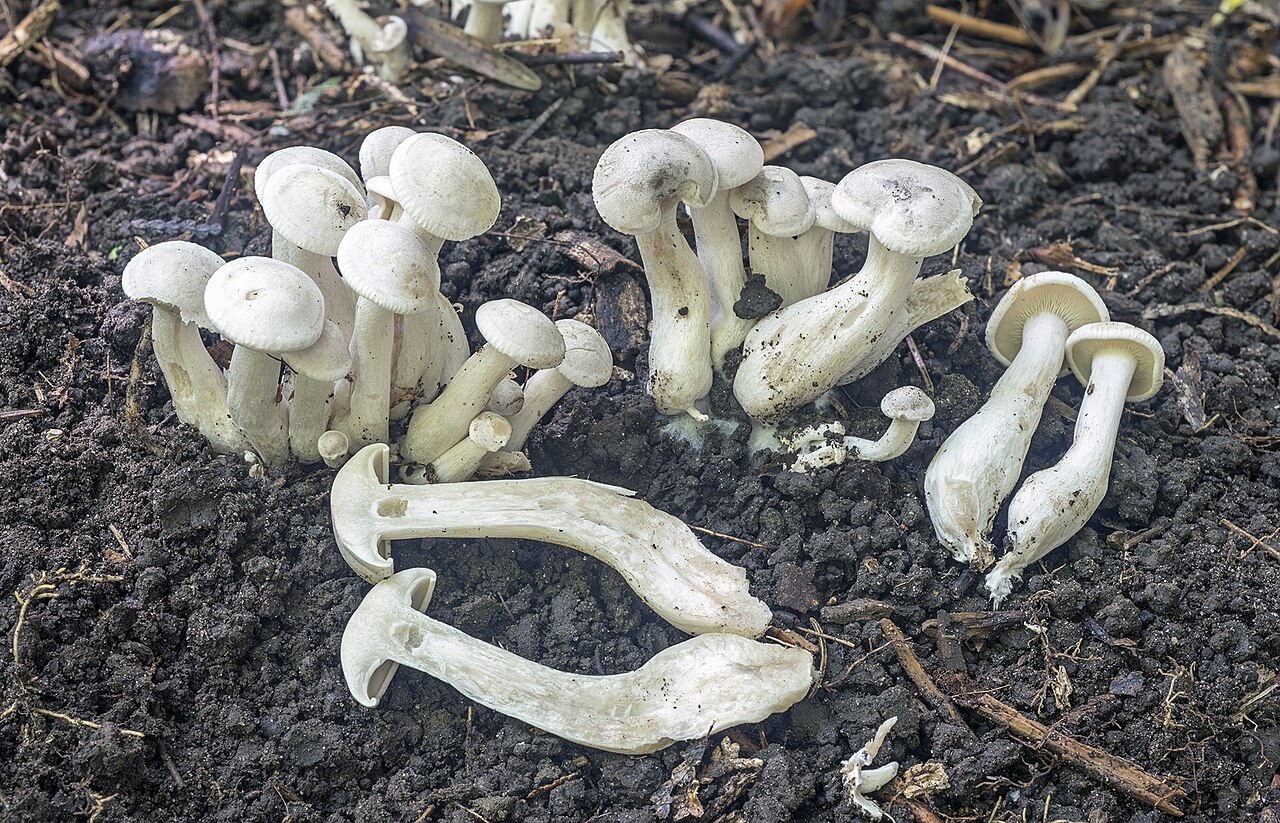
Photo: Robert (the 3 foragers) (the3foragers) · CC BY-SA 3.0 · Photo source · License
_Vizzini,_P._Alvarado,_G._Moreno_%26_Consiglio_925833.jpg)
Description
An entirely white to slightly greyish gilled mushroom growing in dense clusters along woodland paths, often developing a more unpleasant smell with age.
Identification features
The cap is smooth, dry and white, initially convex with an inrolled margin and later flatter. Gills are white and crowded. The stem is firm, white, fibrous, often curved and enlarged below; stems in a cluster are tightly packed.
Identification checklist
Check the entirely white colour, dense clustered growth, white crowded gills and firm white stems packed closely together. Spore print is white. With white-gilled mushrooms always document the base and gills.
Detailed features
- Cap
- An entirely white to slightly greyish gilled mushroom growing in dense clusters along woodland paths; with age it often develops a more unpleasant smell.
- Hymenophore
- Gills are white and crowded.
- Stem
- The stem is firm, white, fibrous, often curved and enlarged below; stems in a cluster are tightly packed.
- Flesh
- White and elastic.
- Smell
- Initially mildly mealy, later unpleasant.
- Spore print
- White.
Size
- Cap diameter
- 2–7 cm
- Stem height
- 4–10 cm
- Stem diameter
- 1–2 cm
Habitat
Saprotrophic on grassy edges of woodland tracks and roads, often in upland areas; late summer and autumn.
Fruiting period
August, September, October
Ecology
- Trophic mode
- Saprotrophic
- Substrate
- Grassland, Disturbed soil
- Notes
- Saprotrophic species. Saprotrophic on grassy edges of woodland tracks and roads, often in upland areas; late summer and autumn.
How to separate similar species
Livid entoloma can be similarly pale but develops pink gills and usually does not form the same dense clusters. Some white Clitocybe-like mushrooms are poisonous. White colour alone is never enough.
Similar species
- Livid entoloma (Entoloma sinuatum) DANGEROUS
E. sinuatum is larger, its gills become pink with maturity, and it is poisonous; L. connata typically grows in dense clusters.
- Clustered domecap (Lyophyllum decastes)
- Clitocybe species
Interesting facts
Did you know? In a cluster the stems are tightly packed but are described as not actually fused together.