Species details
Clustered domecap
Lyophyllum decastes
Traditionally edible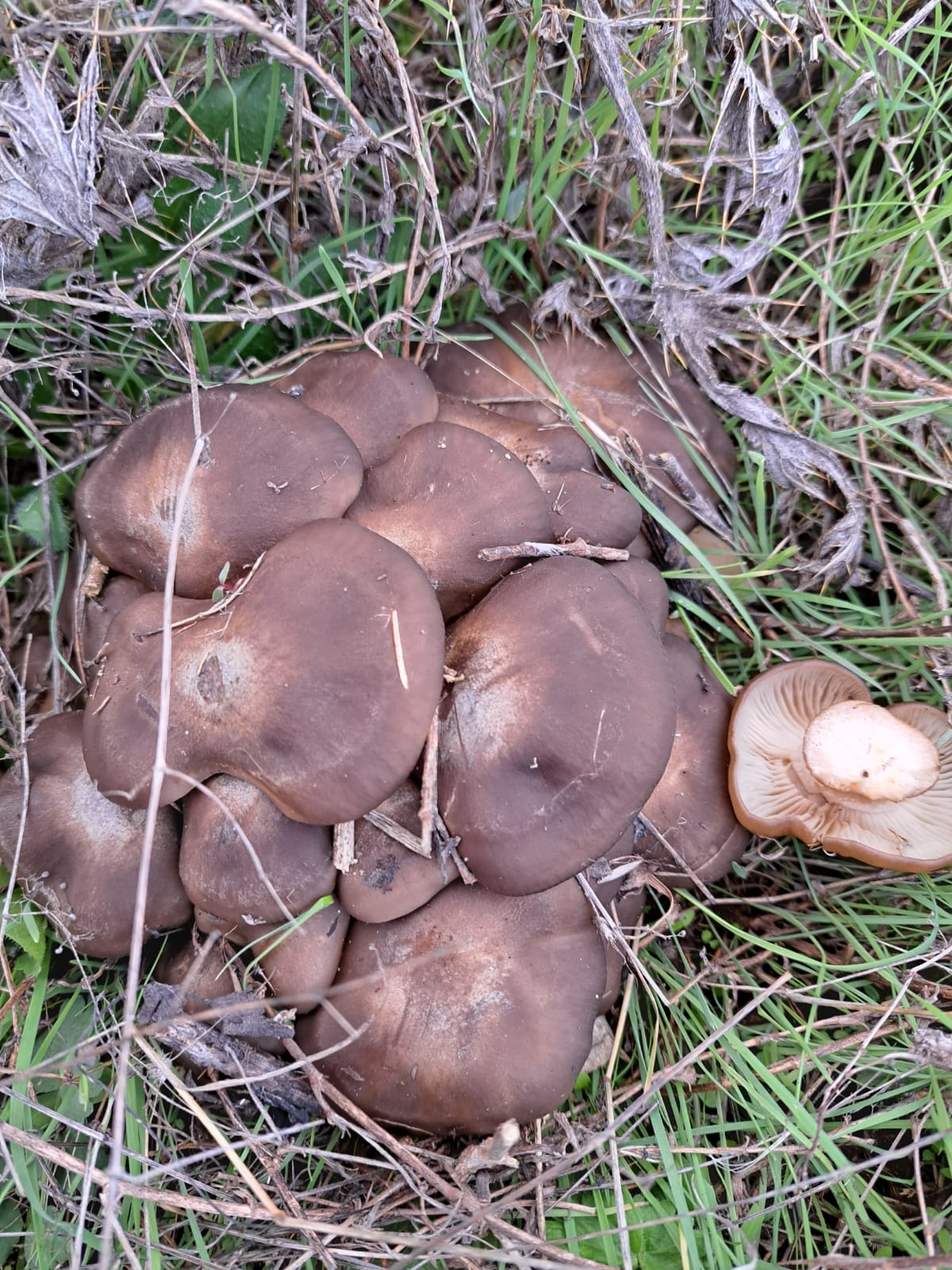
Photo: Jose Angel Urquia Goitia · CC BY-SA 4.0 · Photo source · License

Description
A brown to grey-brown gilled mushroom characteristically forming large dense clusters, with white to greyish gills and curved stems often fused at the base.
Identification features
The cap is smooth, brown and fades with age, initially convex and later flattened. Gills are crowded, whitish to grey. The stem is white, firm and often curved; several stems may be fused at the base.
Identification checklist
Check for dense clustered growth, a smooth brown to grey-brown cap, crowded whitish to grey gills and firm pale stems often tightly joined or fused at the base. Spore print is white.
Detailed features
- Cap
- A brown to grey-brown gilled mushroom characteristically growing in large dense clusters, with white to greyish gills and curved stems that may fuse at the base.
- Hymenophore
- Gills are crowded, whitish to grey.
- Stem
- The stem is white, firm and often curved; several stems may be fused at the base.
- Flesh
- Nearly white, elastic and firm.
- Smell
- Pleasant, mild smell.
- Spore print
- White.
Size
- Cap diameter
- 5–10 cm
- Stem height
- 5–12 cm
- Stem diameter
- 0,5–1,5 cm
Habitat
In woodland, parks, gardens and along paths, often on disturbed soil; mainly in autumn.
Fruiting period
September, October, November
Ecology
- Trophic mode
- Saprotrophic
- Substrate
- Soil, Grassland, Disturbed soil
- Notes
- Saprotrophic species. In woodland, parks, gardens and along paths, often on disturbed soil; mainly in autumn.
How to separate similar species
White domecap is more uniformly white and FungiTrail does not recommend it for food. Armoured domecap has a darker cap with tougher skin. Other Lyophyllum species may blacken when bruised. Some white funnel mushrooms are poisonous.
Similar species
- Lyophyllum loricatum
- White domecap (Leucocybe connata) DANGEROUS
L. connata is almost entirely white and its stems are tightly packed rather than characteristically fused at the base as in L. decastes; it is not recommended for consumption.
- Lyophyllum immundum
Interesting facts
Did you know? It often forms large clusters in which the stems may be fused at the base.