Species details
Weeping bolete
Suillus granulatus
Conditional / expert preparation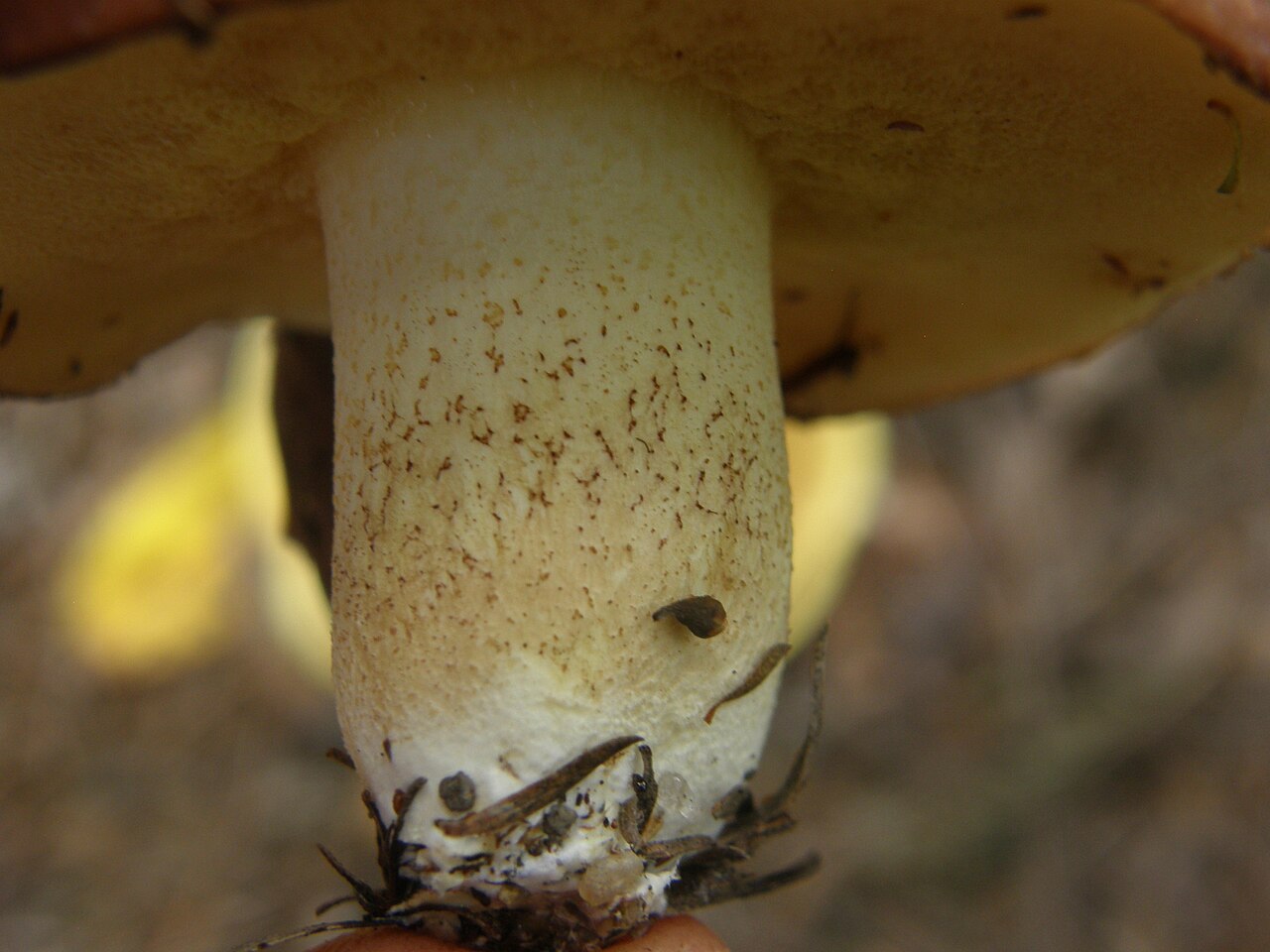
Photo: David Whyte · CC BY-SA 4.0 · Photo source · License

Description
A yellow to orange-brown slimy bolete without a ring, with droplets on pores and stem.
Identification features
Young pores exude milky droplets; the upper stem is finely granular-dotted.
Identification checklist
Check the entire fruitbody for identification. A yellow to orange-brown slimy bolete without a ring, with droplets on pores and stem. Young pores exude milky droplets; the upper stem is finely granular-dotted. Typical habitat: With pine in open woodland, parks, and grassy edges.
Detailed features
- Cap
- 4–10 cm, yellow to yellow-brown, smooth and very slimy when wet; skin peelable.
- Hymenophore
- Yellow to olive pores; young specimens often exude pale milky droplets.
- Stem
- No ring; yellowish and often finely granular near the top from dried droplets.
- Flesh
- Whitish to yellowish, soft, without conspicuous blueing.
- Smell
- Mild.
- Spore print
- Brownish to olive-brown.
Size
- Cap diameter
- 4–10 cm
Habitat
With pine in open woodland, parks, and grassy edges.
Fruiting period
May, June, July, August, September, October, November
Ecology
- Trophic mode
- Mycorrhizal
- Host trees
- Pine (Pinus)
- Substrate
- Forest soil, Grassland
- Notes
- Mycorrhizal with pine, often in open pine stands and adjacent grass.
How to separate similar species
Compare especially with these similar species: Suillus luteus, Suillus collinitus, Suillus mediterraneensis. Check the combination of cap shape and colour, spore-bearing surface, stem, flesh changes and habitat. A single feature or photograph is not enough; if the key characters do not match the description, do not treat the identification as confirmed.
Similar species
- Slippery jack (Suillus luteus)
Has a distinct membranous ring on the stem.
- Suillus collinitus (Suillus collinitus)
Milky droplets are less typical; pink mycelium is often present at the base.
- Suillus mediterraneensis
A warmth-loving similar species with different tones; also check host pine and microscopic characters.