Species details
Suillus collinitus
Suillus collinitus
Traditionally edible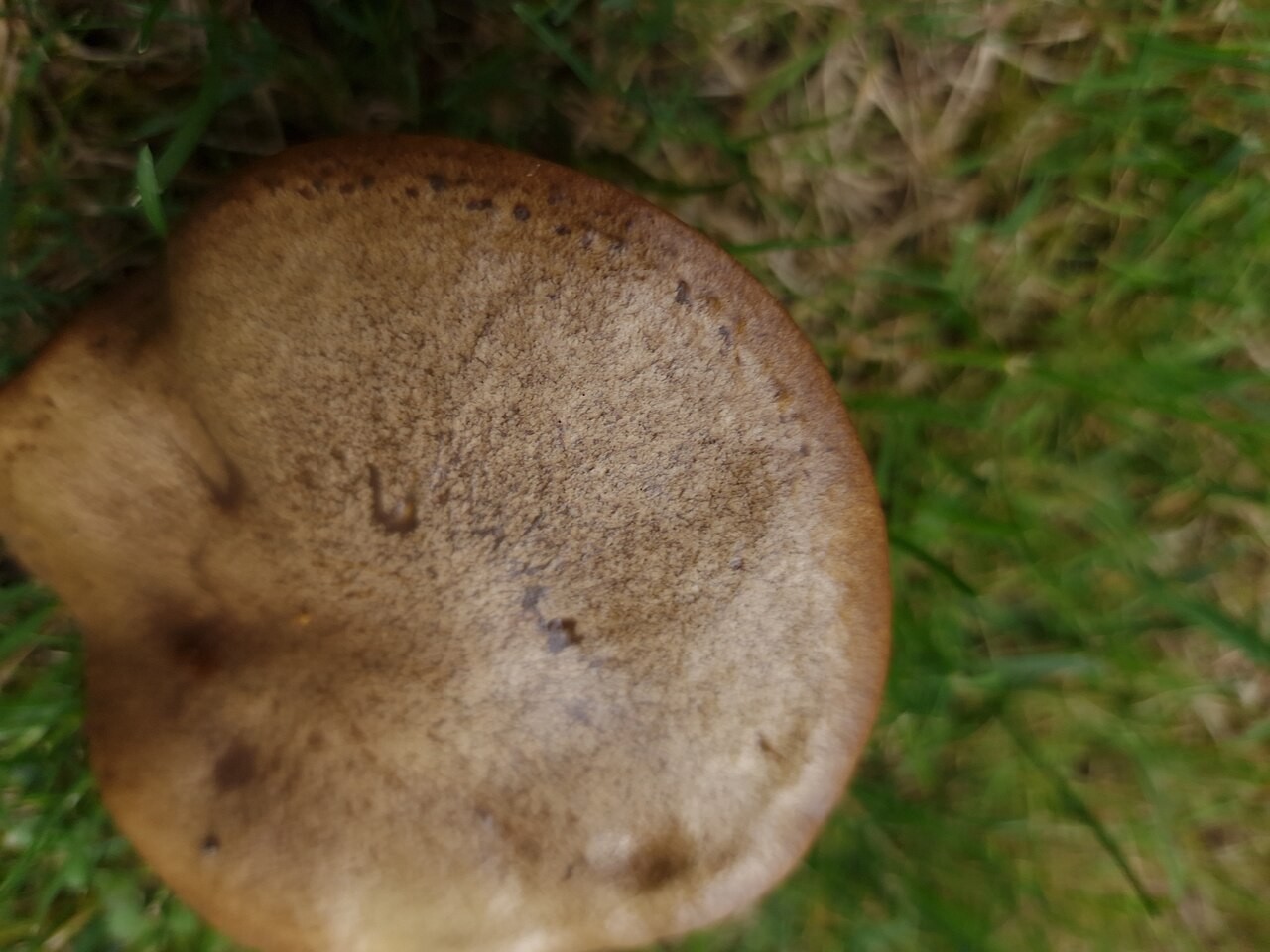
Photo: Joe Carmichael · CC0 · Photo source · License

Description
A brown sticky Suillus without a ring, with yellow pores, fine brown dots on the stem, and characteristic pink mycelium at the base.
Identification features
The cap is chestnut-brown, sticky, and dark-fibrillose. Tubes and pores are yellow. The stem lacks a ring and has pink mycelium at the base.
Identification checklist
Check the lack of a ring, yellow pores, fine brown stem dots, and especially the pink mycelium at the base.
Detailed features
- Cap
- The cap is chestnut-brown, sticky, and dark-fibrillose.
- Hymenophore
- Tubes and pores are yellow.
- Stem
- The stem lacks a ring and has pink mycelium at the base.
- Flesh
- White, soft and elastic; generally unchanged in air.
- Smell
- No distinctive smell.
- Spore print
- Yellow-brown.
Size
- Cap diameter
- 5–12 cm
- Stem height
- 5–9 cm
- Stem diameter
- 1–1,5 cm
Habitat
Mycorrhizal mainly with pines, especially in warmer habitats, mostly in autumn.
Fruiting period
September, October
Ecology
- Trophic mode
- Mycorrhizal
- Host trees
- Pine (Pinus)
- Substrate
- Forest soil
- Notes
- Mycorrhizal mainly with pines, especially in warmer habitats, mostly in autumn.
How to separate similar species
Suillus granulatus is very similar but usually lacks the characteristic pink basal mycelium. Suillus luteus has a ring.
Similar species
Interesting facts
Did you know? Pink basal mycelium and absence of a ring are very useful identification characters.