Species details
Sticky bolete
Suillus viscidus
Conditional / expert preparation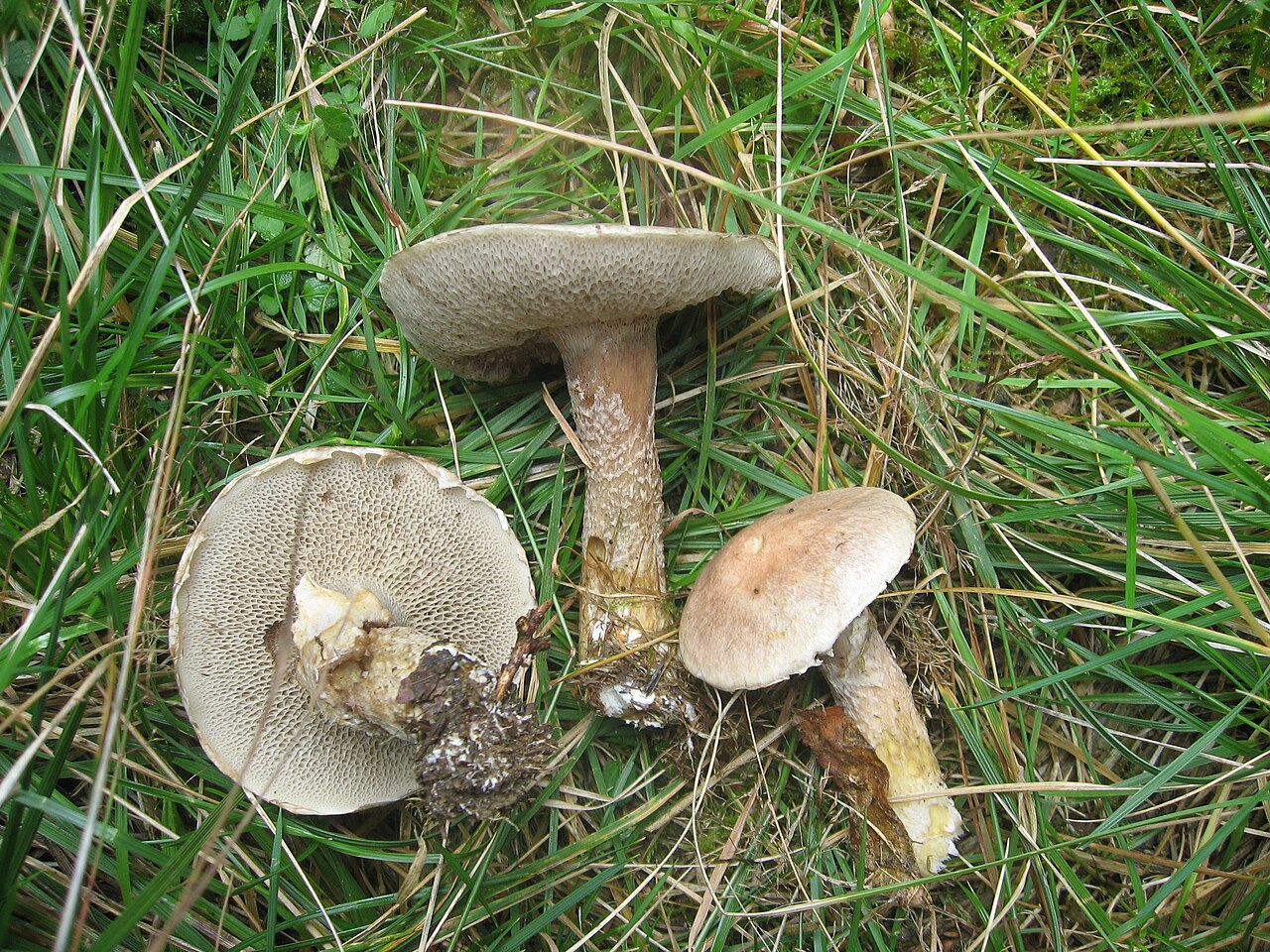
Photo: Dezidor · CC BY-SA 2.5 · Photo source · License

Description
A grey to olive-grey, very slimy bolete closely associated with larch.
Identification features
The cap is strongly slimy, the stem has a ring, and pores are greyish to olive.
Identification checklist
Check the entire fruitbody for identification. A grey to olive-grey, very slimy bolete closely associated with larch. The cap is strongly slimy, the stem has a ring, and pores are greyish to olive. Typical habitat: Under larch in woodland, parks and plantations.
Detailed features
- Cap
- 4–12 cm, hemispherical to convex, grey-greenish to grey-brown, smooth and strongly slimy.
- Hymenophore
- Tubes initially whitish, later grey-greenish; pores become broader and more angular with age.
- Stem
- 4–7 × 1–2 cm, grey-yellowish to brownish, sometimes reticulate above the veil; the ring or veil remnant is delicate and may disappear.
- Flesh
- White, becoming greyish to greenish mottled when cut, especially soft and watery in older specimens.
- Smell
- Pleasant, indistinct.
- Spore print
- Tobacco-brown.
Size
- Cap diameter
- 4–12 cm
- Stem height
- 4–7 cm
- Stem diameter
- 1–2 cm
Habitat
Under larch in woodland, parks and plantations.
Fruiting period
July, August, September, October, November
Ecology
- Trophic mode
- Mycorrhizal
- Host trees
- Larch (Larix)
- Substrate
- Forest soil
- Notes
- Characteristically associated with larch; look for it beneath larches in woodland, parks and plantations.
How to separate similar species
Compare especially with these similar species: Suillus grevillei, Suillus luteus. Check the combination of cap shape and colour, spore-bearing surface, stem, flesh changes and habitat. A single feature or photograph is not enough; if the key characters do not match the description, do not treat the identification as confirmed.
Similar species
- Larch bolete (Suillus grevillei)
Larch bolete is usually yellow to orange rather than predominantly grey or grey-green.
- Slippery jack (Suillus luteus)
Slippery jack is mainly associated with pine and has a darker brown cap and more prominent ring.
Interesting facts
Did you know? The host tree is a very useful clue: this species is a characteristic associate of larch.