Species details
Soapy knight
Tricholoma saponaceum
Inedible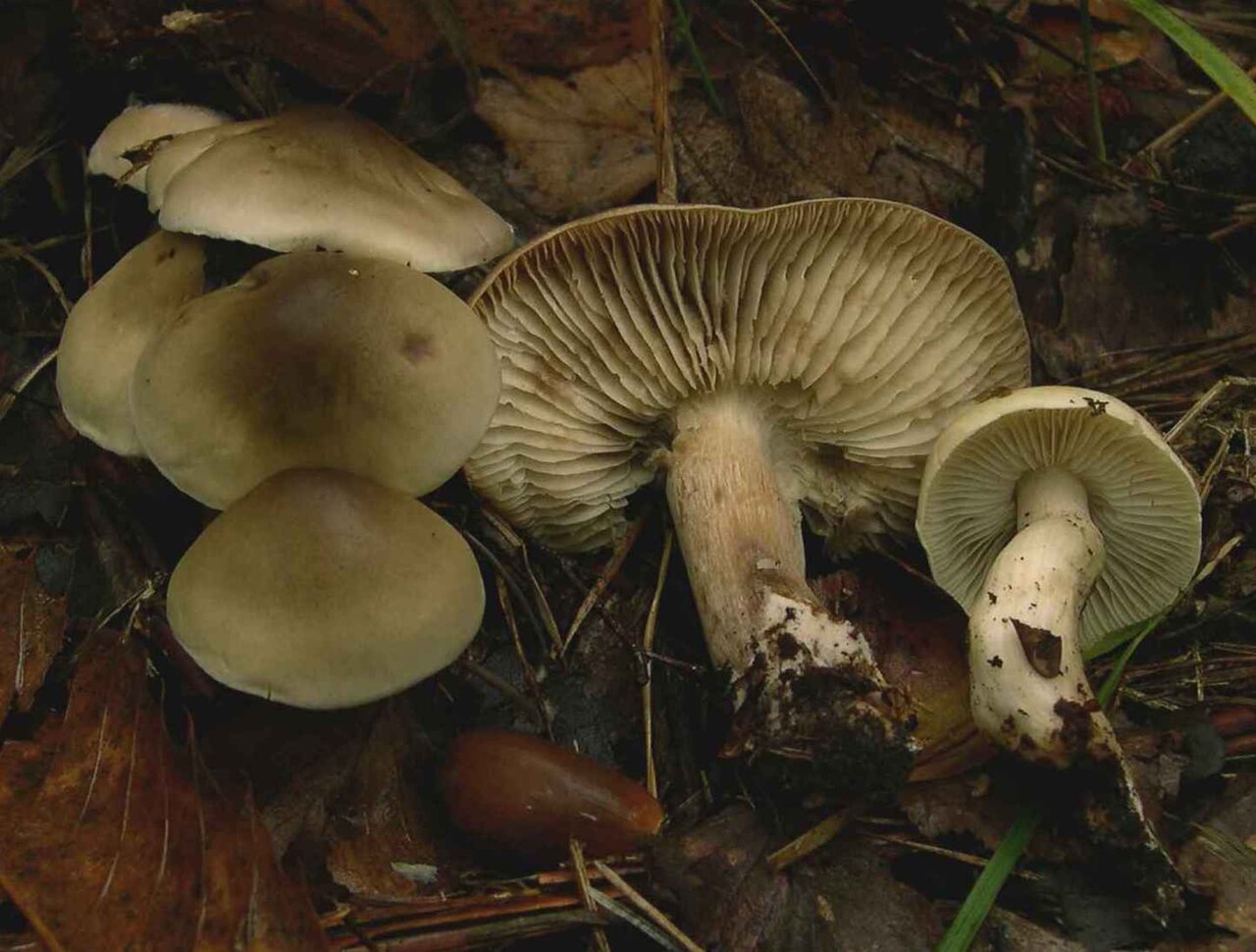
Photo: Archenzo · CC BY-SA 3.0 · Photo source · License

Description
A very variably coloured Tricholoma with a characteristic soapy smell and often pinkish stem base.
Identification features
Gills are whitish to greenish, flesh may pinken at the stem base, and smell is an important clue.
Identification checklist
Check the entire fruitbody for identification. A very variably coloured Tricholoma with a characteristic soapy smell and often pinkish stem base. Gills are whitish to greenish, flesh may pinken at the stem base, and smell is an important clue. Typical habitat: Various deciduous, coniferous and mixed woodland.
Detailed features
- Cap
- 5–10 cm, fleshy, convex to broadly umbonate and smooth; highly variable from greenish and grey to brownish or nearly white.
- Hymenophore
- Gills whitish to faintly greenish, thick and well spaced, almost free at the stem.
- Stem
- 5–10 × 1–2 cm, cylindrical to somewhat spindle-shaped, pale, smooth or finely darker-scaled.
- Flesh
- White; pinkish-red patches can develop in air, especially in the stem.
- Smell
- Very characteristic smell of laundry soap.
- Spore print
- White.
Size
- Cap diameter
- 5–10 cm
- Stem height
- 5–10 cm
- Stem diameter
- 1–2 cm
Habitat
Various deciduous, coniferous and mixed woodland.
Fruiting period
July, August, September, October, November
Ecology
- Trophic mode
- Mycorrhizal
- Substrate
- Forest soil
- Notes
- A mycorrhizal species beneath conifers and broadleaved trees, often in groups.
How to separate similar species
Compare especially with these similar species: Tricholoma sejunctum, Tricholoma terreum. Check the combination of cap shape and colour, spore-bearing surface, stem, flesh changes and habitat. A single feature or photograph is not enough; if the key characters do not match the description, do not treat the identification as confirmed.
Similar species
- Deceiving knight (Tricholoma sejunctum)
Tricholoma sejunctum has a yellow-green radially fibrillose cap and smells mealy rather than soapy.
- Grey knight (Tricholoma terreum) DANGEROUS
Grey knight is usually smaller, with a grey fibrillose-scaly cap and no characteristic soap smell.
Interesting facts
Did you know? The soap smell is one of the most useful characters of this highly variable species.