Species details
Shield pinkgill
Entoloma clypeatum
Extra caution required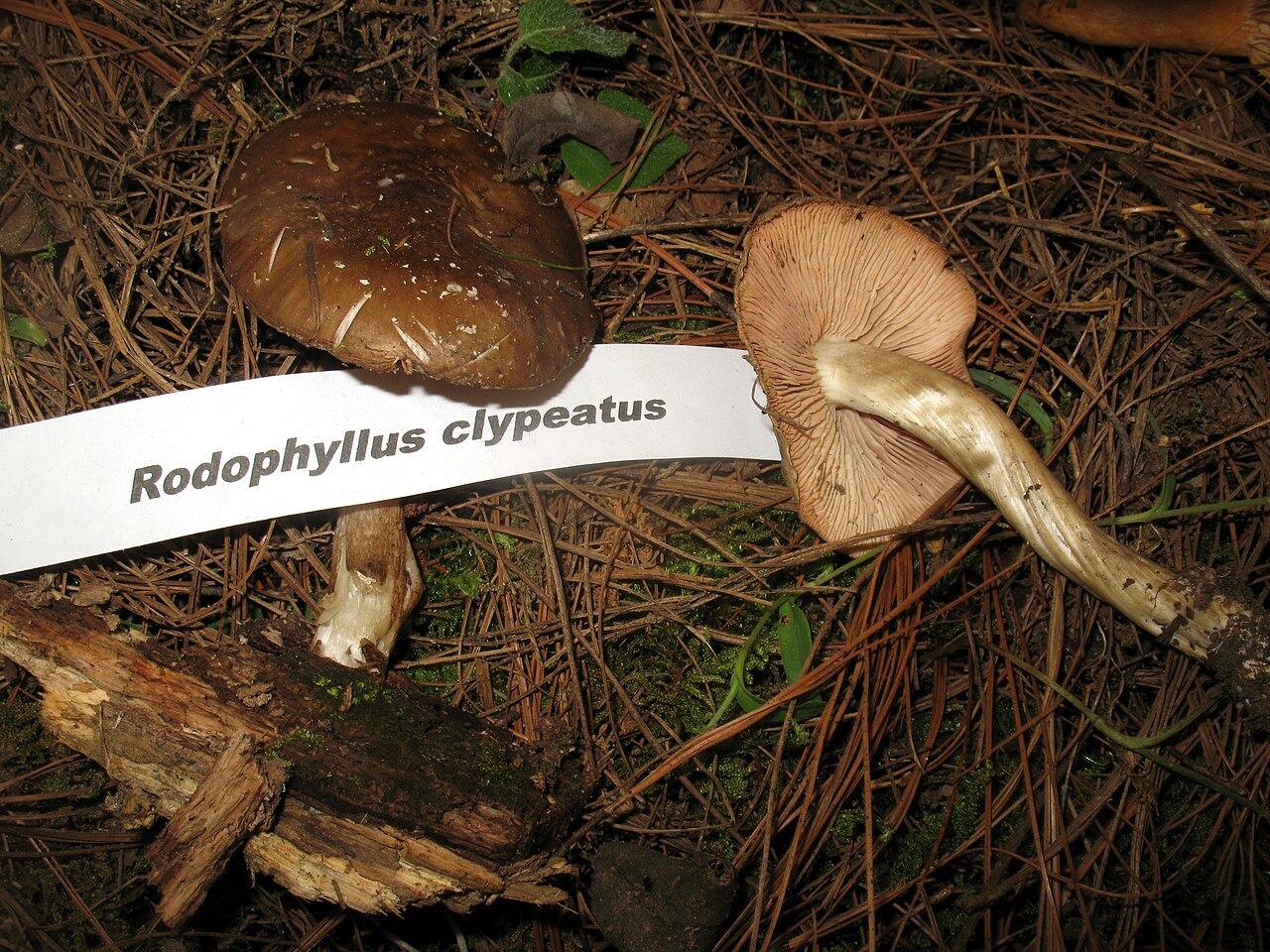
Photo: Alan Rockefeller · CC BY-SA 3.0 · Photo source · License

Description
A spring grey-brown pinkgill often associated with fruit trees and other members of the rose family.
Identification features
Gills start pale and become pink from the spores; the stem is whitish and ringless.
Identification checklist
Check the entire fruitbody for identification. A spring grey-brown pinkgill often associated with fruit trees and other members of the rose family. Gills start pale and become pink from the spores; the stem is whitish and ringless. Typical habitat: Orchards, gardens and hedges with plum, apple, hawthorn and related trees.
Detailed features
- Cap
- 4–10 cm, umbonate-convex to expanded, brownish and smooth, sometimes watery-translucent and faintly striate at the margin when moist.
- Hymenophore
- Gills initially whitish, becoming pink-brown with maturity, moderately crowded, adnate to slightly decurrent.
- Stem
- 6–10 × 1–1.5 cm, whitish, cylindrical, smooth to fibrillose-shining and ringless.
- Flesh
- Whitish and fibrous, readily becoming water-soaked.
- Smell
- Pleasantly mealy.
- Spore print
- Pink-brown.
Size
- Cap diameter
- 4–10 cm
- Stem height
- 6–10 cm
- Stem diameter
- 1–1,5 cm
Habitat
Orchards, gardens and hedges with plum, apple, hawthorn and related trees.
Fruiting period
April, May, June
Ecology
- Host trees
- Apple (Malus), Pear (Pyrus)
- Substrate
- Grassland
- Notes
- Characteristically appears in spring in grass beneath apple, pear and other fruit trees.
How to separate similar species
Compare especially with these similar species: Entoloma sinuatum, Calocybe gambosa. Check the combination of cap shape and colour, spore-bearing surface, stem, flesh changes and habitat. A single feature or photograph is not enough; if the key characters do not match the description, do not treat the identification as confirmed.
Similar species
- Livid entoloma (Entoloma sinuatum) DANGEROUS
Livid pinkgill is larger, fruits later and is poisonous; a pink spore print alone is not enough to separate them.
- St George's mushroom (Calocybe gambosa)
St George’s mushroom has white gills that do not turn pink and a white spore print.
Interesting facts
Did you know? Spring fruiting under fruit trees is an important ecological clue for this species.