Species details
Peppery bolete
Chalciporus piperatus
Inedible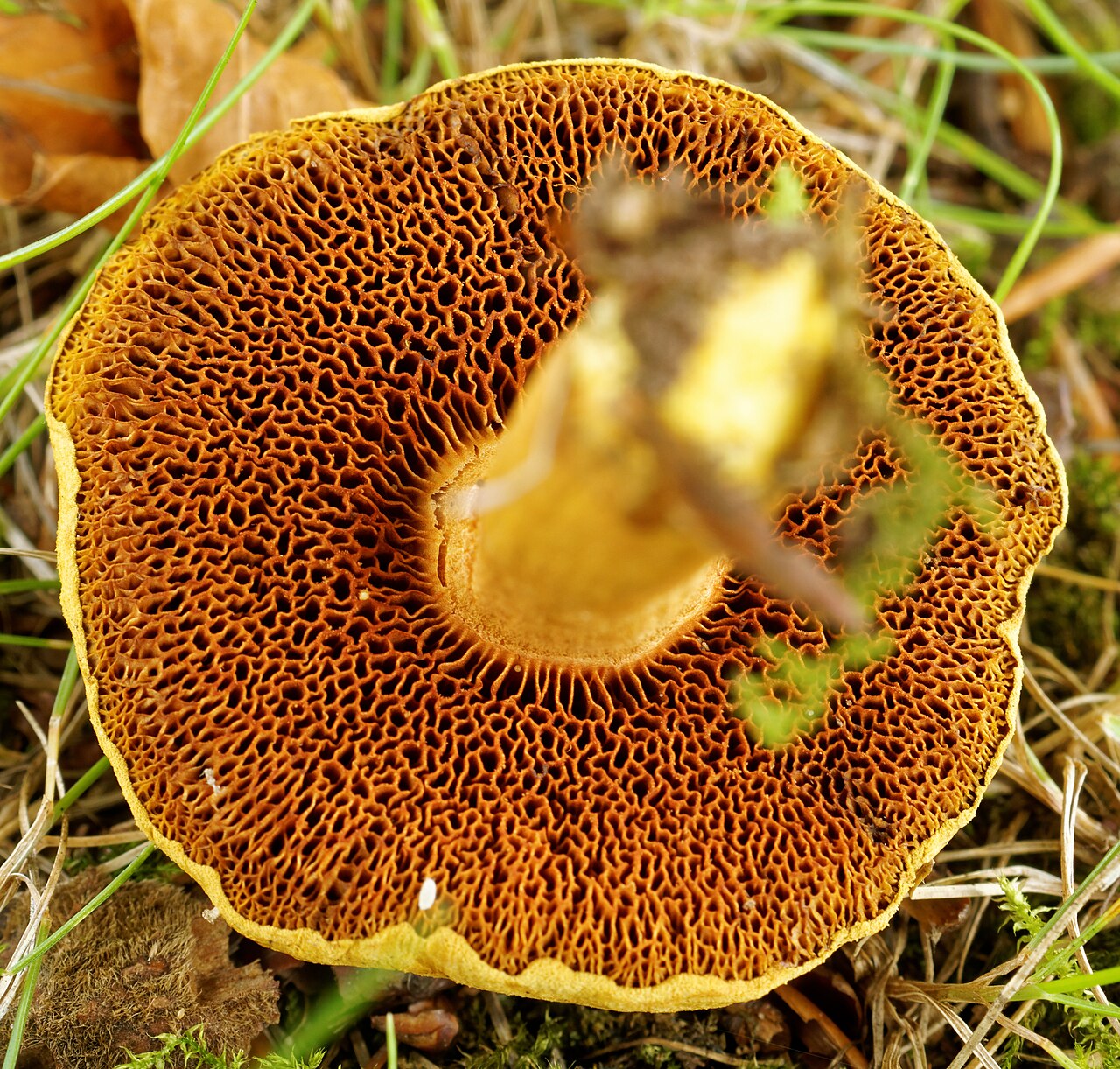
Photo: Lukas from London, England · CC BY-SA 2.0 · Photo source · License
.jpg)
Description
A small brown bolete with reddish-brown pores and strongly peppery flesh.
Identification features
The stem is slender, yellow to brown, and lacks a net; mature pores are cinnamon-coloured.
Identification checklist
Check the entire fruitbody for identification. A small brown bolete with reddish-brown pores and strongly peppery flesh. The stem is slender, yellow to brown, and lacks a net; mature pores are cinnamon-coloured. Typical habitat: Mainly in conifer and mixed woodland, often with pine and spruce.
Detailed features
- Cap
- 3–5 cm, ochre to brown, smooth and shiny; slightly sticky when wet.
- Hymenophore
- Pores characteristically copper to reddish-brown.
- Stem
- Slender, yellowish to brownish; the base is often distinctly yellow.
- Flesh
- Yellowish, with an intensely peppery character.
- Smell
- Not distinctive.
- Spore print
- Brownish.
Size
- Cap diameter
- 3–5 cm
Habitat
Mainly in conifer and mixed woodland, often with pine and spruce.
Fruiting period
June, July, August, September, October, November
Ecology
- Trophic mode
- Mycorrhizal
- Host trees
- Spruce (Picea), Pine (Pinus)
- Substrate
- Forest soil
- Notes
- Occurs in coniferous and mixed woodland, often with conifers.
How to separate similar species
Compare especially with these similar species: Chalciporus rubinus, Imleria badia, Suillus bovinus. Check the combination of cap shape and colour, spore-bearing surface, stem, flesh changes and habitat. A single feature or photograph is not enough; if the key characters do not match the description, do not treat the identification as confirmed.
Similar species
- Chalciporus rubinus
Has more ruby-red pores and a milder taste.
- Bay bolete (Imleria badia)
Has yellow to olive pores that blue rather than copper-red pores.
- Slippery jack (Suillus luteus)
Has yellow pores, a slimy brown cap, and a ring on the stem.