Species details
Orange grisette
Amanita crocea
Conditional / expert preparation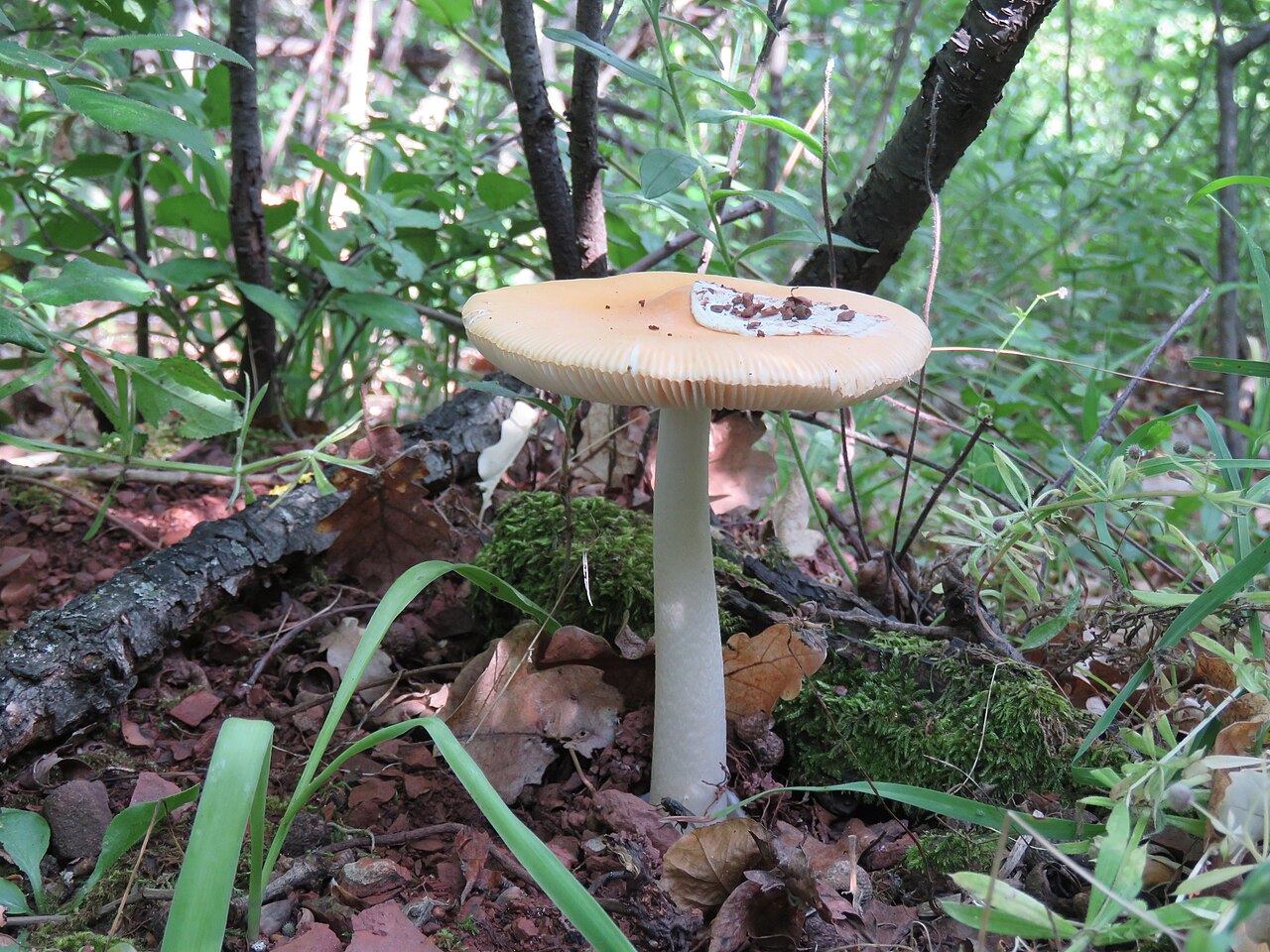
Photo: Zerocool.marko · CC BY-SA 4.0 · Photo source · License

Description
An orange ringless Amanita with a strongly striate cap margin and a sack-like volva.
Identification features
The stem has orange fibrils or zig-zag markings; gills are white to cream.
Identification checklist
Check the entire fruitbody for identification. An orange ringless Amanita with a strongly striate cap margin and a sack-like volva. The stem has orange fibrils or zig-zag markings; gills are white to cream. Typical habitat: Deciduous and mixed woodland, often with birch, beech or oak.
Detailed features
- Cap
- 6–15 cm, initially egg- to bell-shaped, later expanded, orange, with a strongly radially striate margin.
- Hymenophore
- Gills white, crowded, broad and free from the stem.
- Stem
- 10–15 × 1–2 cm, long, orange-fibrillose or zig-zag patterned; no ring, with a large sac-like volva at the base.
- Flesh
- White, brittle and without a marked colour change.
- Smell
- Indistinct.
- Spore print
- White.
Size
- Cap diameter
- 6–15 cm
- Stem height
- 10–15 cm
- Stem diameter
- 1–2 cm
Habitat
Deciduous and mixed woodland, often with birch, beech or oak.
Fruiting period
June, July, August, September, October
Ecology
- Trophic mode
- Mycorrhizal
- Host trees
- Birch (Betula), Beech (Fagus), Oak (Quercus)
- Substrate
- Forest soil, Grassland
- Notes
- A mycorrhizal species of broadleaved and mixed woodland and woodland margins, occurring with several tree species.
How to separate similar species
Compare especially with these similar species: Amanita fulva, Amanita caesarea. Check the combination of cap shape and colour, spore-bearing surface, stem, flesh changes and habitat. A single feature or photograph is not enough; if the key characters do not match the description, do not treat the identification as confirmed.
Similar species
- Tawny grisette (Amanita fulva)
Tawny grisette is usually browner and lacks the characteristic orange-fibrillose stem.
- Caesar's mushroom (Amanita caesarea)
Caesar’s mushroom has yellow gills and a yellow stem and usually a ring; orange grisette has white gills and no ring.
Interesting facts
Did you know? Like other grisettes it lacks a ring, so seeing the entire sac-like stem base is very important for identification.