Species details
Mountain polypore
Bondarzewia mesenterica
Conditional / expert preparation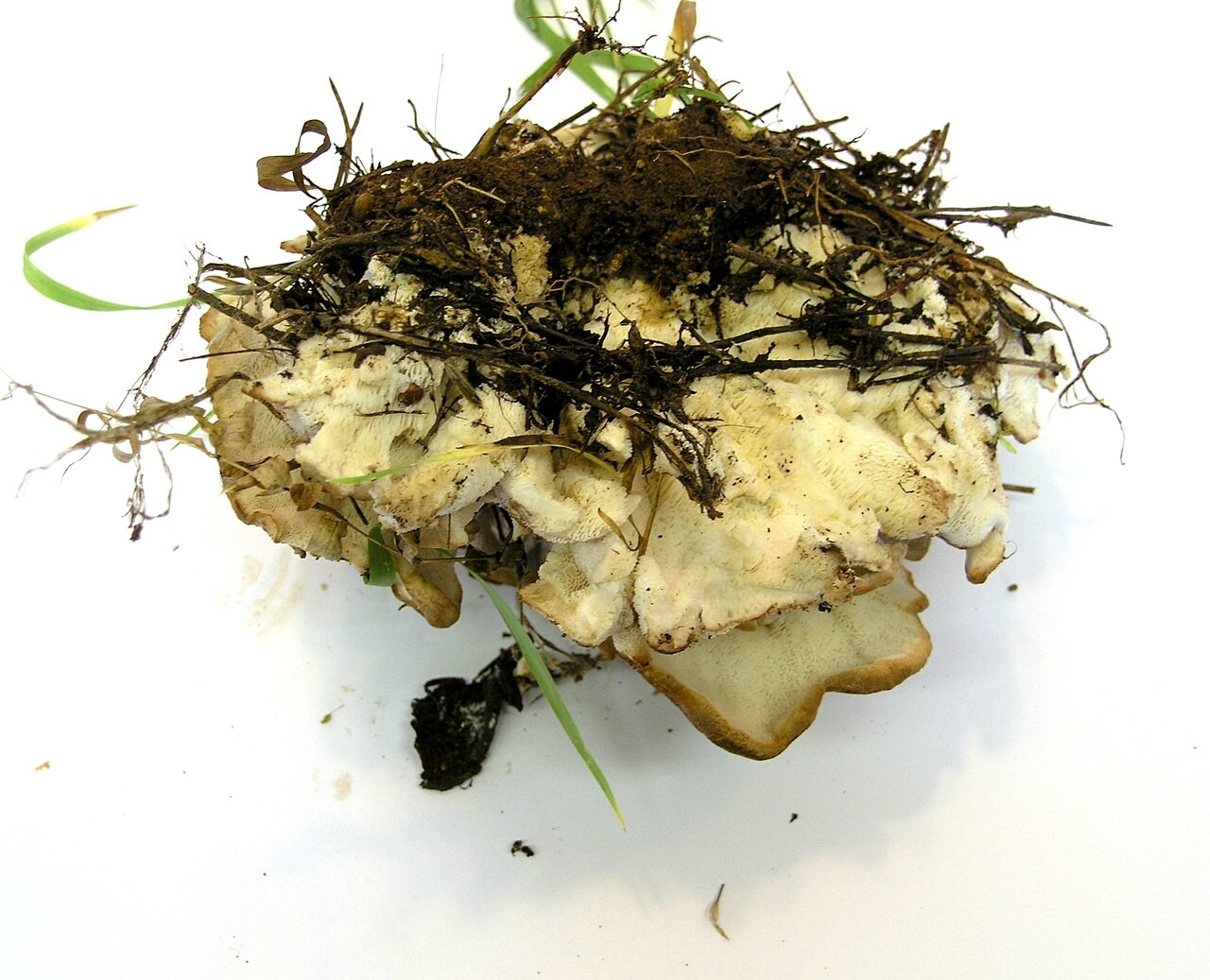
Photo: This image was created by user Jeff Hitchcock (JHitch) at Mushroom Observer , a source for mycological images. You can contact this user here . · CC BY-SA 3.0 · Photo source · License
_Kreisel_365275.jpg)
Description
A large clustered polypore with multiple brown fan-shaped caps, characteristically associated with old fir trees; protected in Slovenia.
Identification features
Several fan-shaped ochre-brown to brown caps arise from a common base. The white to ochre pores beneath do not blacken when pressed.
Identification checklist
Key clues are the large clustered form, fir as host and pores that do not blacken under pressure.
Detailed features
- Hymenophore
- The white to ochre pores beneath do not blacken when pressed.
Habitat
Grows parasitically on roots of old fir trees in summer and autumn; uncommon.
Fruiting period
June, July, August, September, October, November
Ecology
- Trophic mode
- Parasitic
- Host trees
- Fir (Abies)
- Substrate
- Roots
- Notes
- Grows parasitically on roots of old fir trees in summer and autumn; uncommon.
How to separate similar species
Meripilus giganteus blackens strongly when bruised; Grifola frondosa has narrower caps and more often grows with oak or chestnut.
Similar species
- Giant polypore (Meripilus giganteus)
- Hen of the woods (Grifola frondosa)
- Bondarzewia berkeleyi
Conservation
- Protected species
- Yes
- Red list
- R – rare species
- Notes
- The species is legally protected in Slovenia under the regulation on protected wild fungi. On the Slovenian Red List: R – rare species. In the 2011 Slovenian regulation the species is listed as Bondarzewia montana; FungiTrail uses the more recent name Bondarzewia mesenterica.