Species details
Hen of the woods
Grifola frondosa
Extra caution required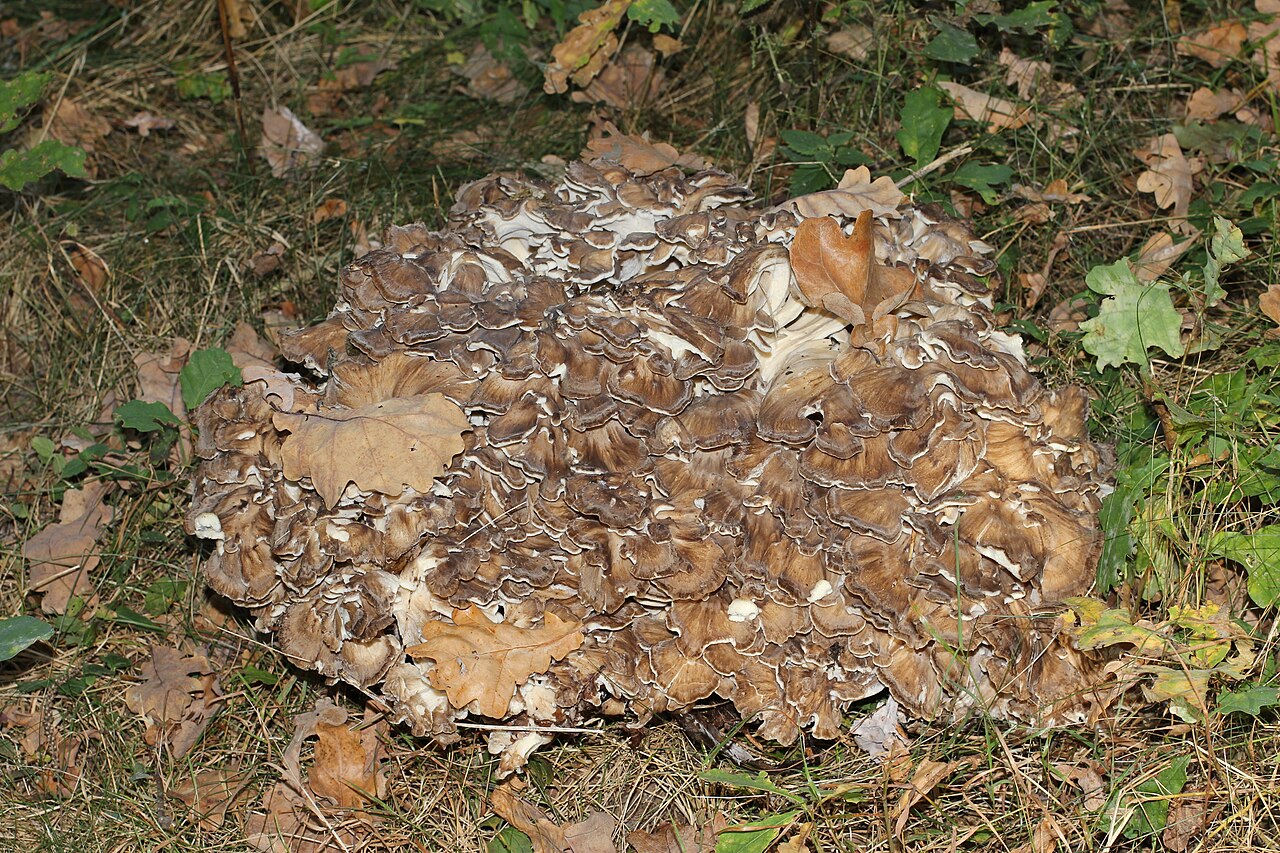
Photo: George Chernilevsky · Public domain · Photo source

Description
A large clustered fruit body of many grey-brown fan-shaped caps joined at a common base.
Identification features
The underside has fine white pores; individual fans have short lateral stems.
Identification checklist
Check the entire fruitbody for identification. A large clustered fruit body of many grey-brown fan-shaped caps joined at a common base. The underside has fine white pores; individual fans have short lateral stems. Typical habitat: At the base of old oaks, on roots and stumps, often recurring at the same site.
Detailed features
- Cap
- The whole fruitbody may reach about 50 cm and is made of many fan-shaped grey to brown caps, each about 4–10 cm.
- Hymenophore
- White pored fertile surface; tiny pores run down the fused stems.
- Stem
- Many short white stems are fused into a common central base; individual stems are about 1–4 cm thick.
- Flesh
- White, firm and brittle; becomes tough with age and normally does not blacken.
- Smell
- Slightly mealy.
- Spore print
- White.
Habitat
At the base of old oaks, on roots and stumps, often recurring at the same site.
Fruiting period
August, September, October
Ecology
- Trophic mode
- Parasitic
- Host trees
- Oak (Quercus), Sweet chestnut (Castanea)
- Substrate
- Roots, Stumps, Dead hardwood
- Notes
- A parasite at roots and bases of deciduous trees, especially oak and sweet chestnut; it can also continue on dead wood.
How to separate similar species
Compare especially with these similar species: Meripilus giganteus, Polyporus umbellatus, Bondarzewia mesenterica. Check the combination of cap shape and colour, spore-bearing surface, stem, flesh changes and habitat. A single feature or photograph is not enough; if the key characters do not match the description, do not treat the identification as confirmed.
Similar species
- Giant polypore (Meripilus giganteus)
Characteristically blackens when bruised and aged; caps are usually larger and coarser.
- Polyporus umbellatus
Has many more separate, centrally stalked caps on strongly branched stems.
- Mountain polypore (Bondarzewia mesenterica)
Usually forms less finely branched, thicker caps and is often associated with fir.
Conservation
- Protected species
- Yes
- Red list
- R – rare species
- Notes
- The species is legally protected in Slovenia under the regulation on protected wild fungi. On the Slovenian Red List: R – rare species.