Species details
Lumpy bracket
Trametes gibbosa
Inedible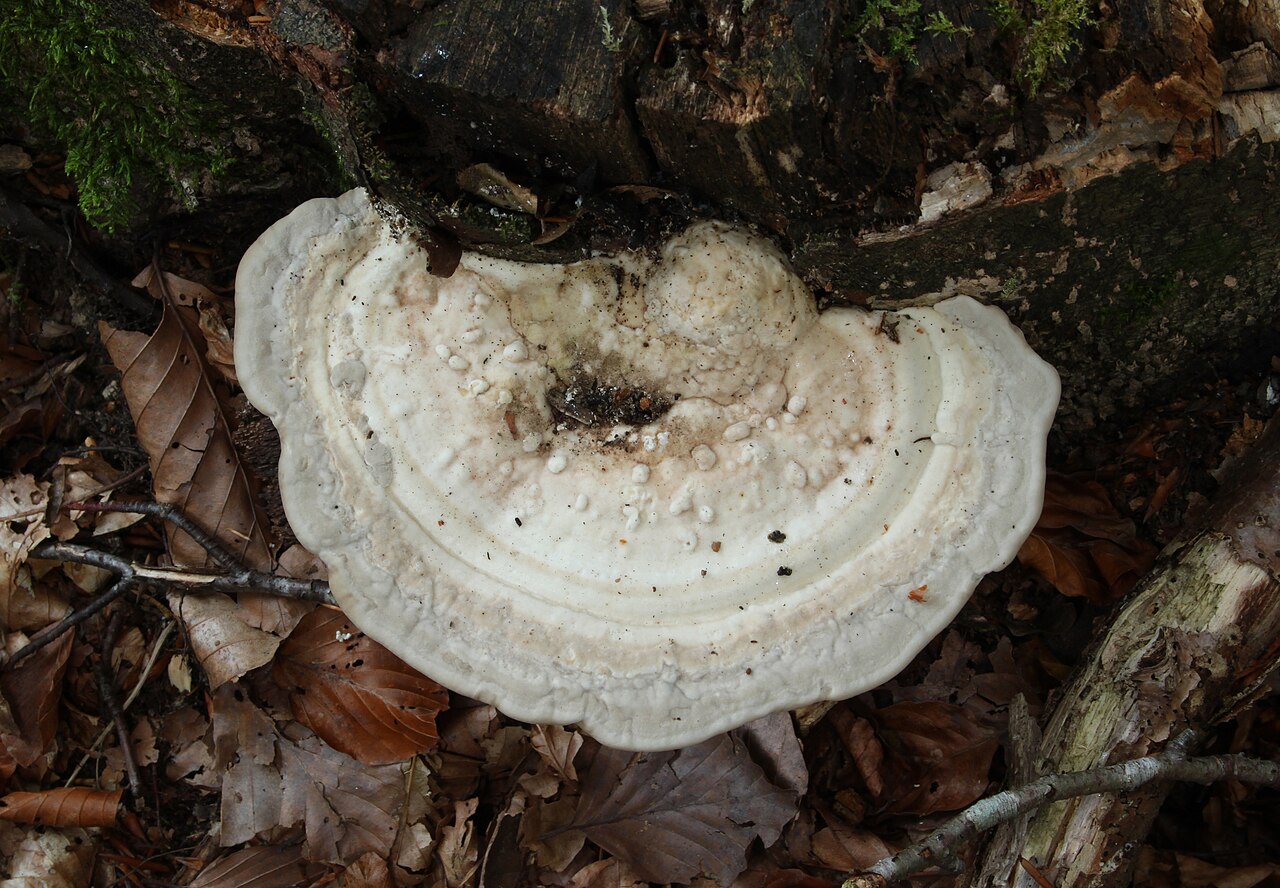
Photo: Holger Krisp · CC BY 3.0 · Photo source · License

Description
A large white to cream bracket on hardwood with a lumpy upper surface and elongated to maze-like pores.
Identification features
Young fruitbodies are chalk-white and may be finely hairy; older ones often become greenish from algae. The underside has elongated yellow-white pores; there is no stem and the flesh is corky.
Identification checklist
Check the entire fruitbody for identification. A large white to cream bracket on hardwood with a lumpy upper surface and elongated to maze-like pores. Young fruitbodies are chalk-white and may be finely hairy; older ones often become greenish from algae. The underside has elongated yellow-white pores; there is no stem and the flesh is corky. On stumps and dead hardwood, especially beech; fruitbodies may persist throughout the year.
Detailed features
- Cap
- A large white to cream bracket fungus on hardwood, with a humped upper surface and elongated to maze-like pores.
- Hymenophore
- The underside has elongated yellow-white pores; there is no stem and the flesh is corky.
- Stem
- The underside has elongated yellow-white pores; there is no stem and the flesh is corky.
- Flesh
- Corky and firm, becoming hard in older fruitbodies.
- Smell
- No particularly distinctive smell.
- Spore print
- White.
Habitat
On stumps and dead hardwood, especially beech; fruitbodies may persist throughout the year.
Fruiting period
January, February, March, April, May, June, July, August, September, October, November, December
Ecology
- Trophic mode
- Saprotrophic
- Host trees
- Beech (Fagus)
- Substrate
- Dead hardwood, Stumps
- Notes
- Saprotrophic species. On stumps and dead hardwood, especially beech; fruitbodies may persist throughout the year.
How to separate similar species
Compare especially with: Daedaleopsis confragosa, Trametes versicolor, Daedalea quercina. A single feature or photograph is not sufficient for reliable identification.
Similar species
Interesting facts
Did you know? Older upper surfaces often turn green from algae while the pale underside retains maze-like pores.