Species details
Ivory funnel
Clitocybe dealbata
Deadly poisonous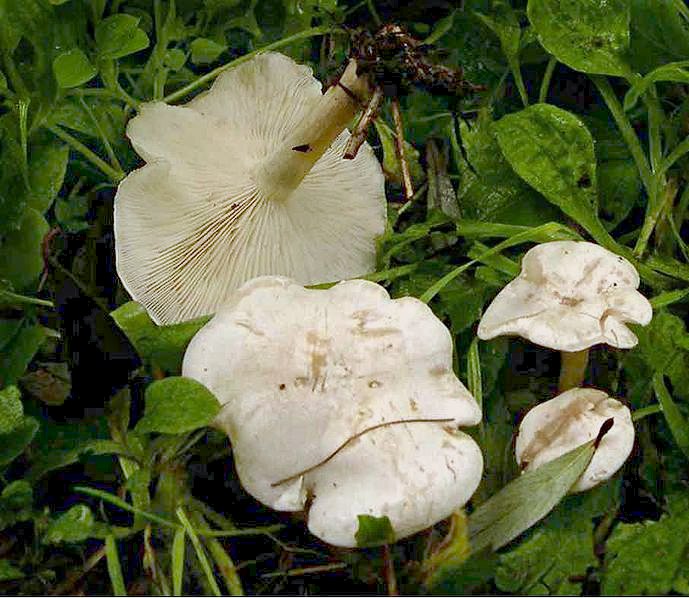
Photo: Archenzo · CC BY 3.0 · Photo source · License

Description
A small whitish to grey funnel in grass with crowded gills running down the stem.
Identification features
The cap may be finely frosted with a wavy margin. It contains muscarine and can cause life-threatening poisoning; small white funnels require expert identification.
Identification checklist
Check the entire fruitbody for identification. A small whitish to grey funnel in grass with crowded gills running down the stem. The cap may be finely frosted with a wavy margin. It contains muscarine and can cause life-threatening poisoning; small white funnels require expert identification. Typical habitat: In meadows, lawns, pastures, parks, and grassy pathsides.
Detailed features
- Cap
- Up to about 5 cm, white to grey-white, initially convex then flat or shallowly funnel-shaped; margin may be wavy and surface finely cracked.
- Hymenophore
- Gills are white, thin, crowded and decurrent.
- Stem
- Up to about 5 × 0.5 cm, white, cylindrical, without a ring.
- Flesh
- White, thin and relatively firm.
- Smell
- Distinctly mealy.
- Spore print
- White.
Size
- Cap diameter
- ≤ 5 cm
- Stem height
- ≤ 5 cm
- Stem diameter
- ≤ 0,5 cm
Habitat
In meadows, lawns, pastures, parks, and grassy pathsides.
Fruiting period
June, July, August, September, October, November
Ecology
- Trophic mode
- Saprotrophic
- Substrate
- Grassland
- Notes
- A saprotroph of grassy ground, growing in meadows, lawns, pastures, parks and along grassy paths.
Distribution
- Notes
- A widespread European species of grassy habitats; its small size makes it easy to overlook.
How to separate similar species
Compare especially with these similar species: Calocybe gambosa, Clitopilus prunulus. Check the combination of cap shape and colour, spore-bearing surface, stem, flesh changes and habitat. A single feature or photograph is not enough; if the key characters do not match the description, do not treat the identification as confirmed.
Similar species
- The miller (Clitopilus prunulus)
The miller is usually larger and develops a pink spore print; ivory funnel has a white spore print and contains dangerous muscarine.
Interesting facts
Did you know? Small white funnels in grassland are a hazardous identification group because they may contain muscarine and resemble edible species.