Species details
Fly agaric
Amanita muscaria
Poisonous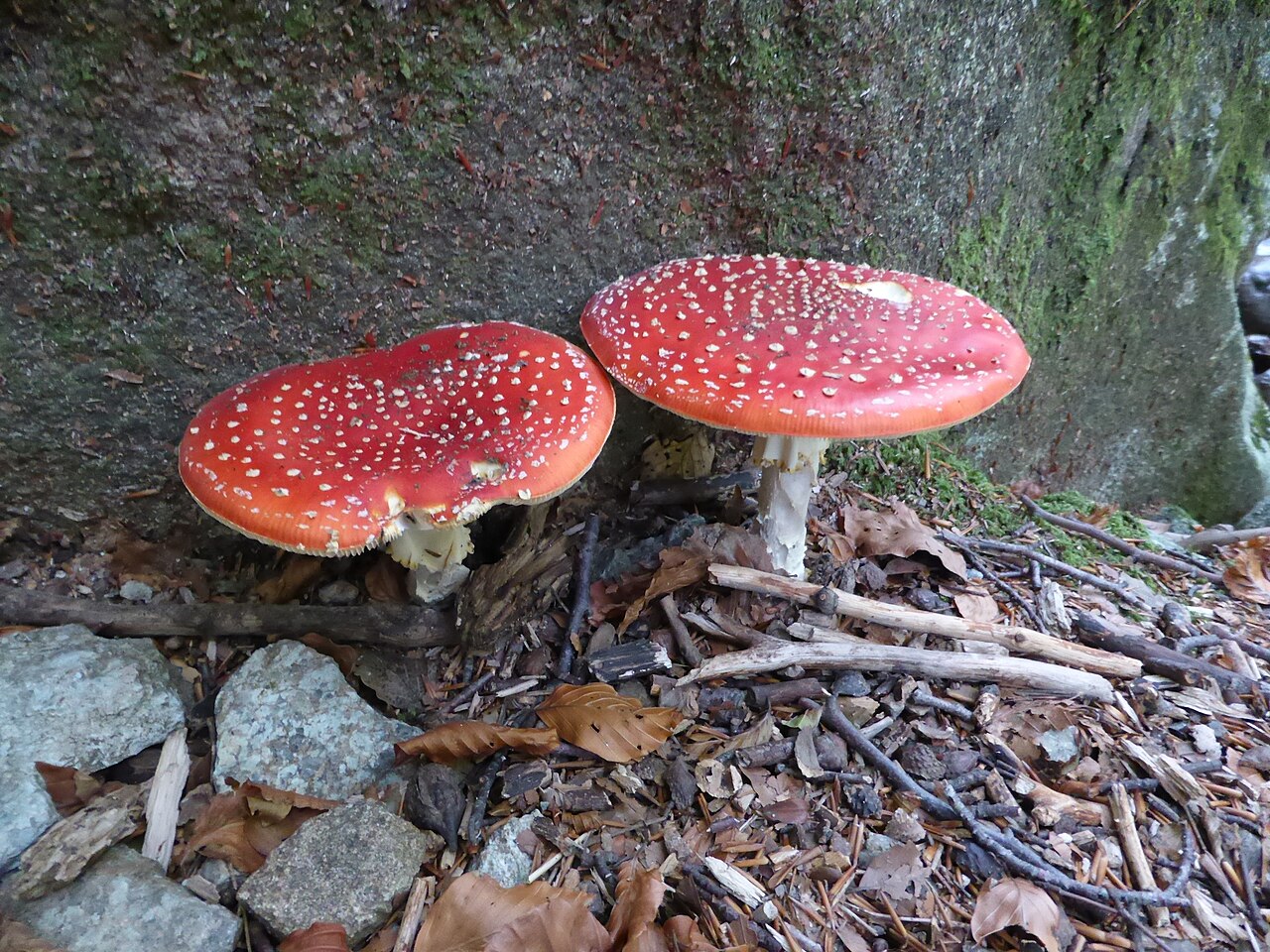
Photo: MartinThoma · CC0 · Photo source · License

Description
A red to orange amanita with white warts, white gills, a ring, and a bulbous base.
Identification features
Rain may wash away the white warts. Ring-like veil remnants often surround the base, and old cap margins are striate.
Identification checklist
The cap is usually red to orange-red with white veil patches that rain may wash away. Gills and stem are white, with a ring on the stem and several bands of volval remnants around the bulbous base.
Detailed features
- Cap
- Bright red to orange-red, often with white veil patches; rain may wash some or all of them away.
- Hymenophore
- Gills are white to slightly yellowish, crowded and free.
- Stem
- White and long, with a ring and enlarged base bearing ragged or ring-like veil remnants.
- Flesh
- White, sometimes yellowish immediately beneath the red cap skin.
- Spore print
- White.
Size
- Cap diameter
- 8–20 cm
- Stem height
- 10–25 cm
- Stem diameter
- 1–3 cm
Habitat
Mycorrhizal with birch, spruce, pine, and other trees on acidic soil.
Fruiting period
July, August, September, October, November
Ecology
- Trophic mode
- Mycorrhizal
- Host trees
- Birch (Betula), Pine (Pinus), Spruce (Picea)
Distribution
- Notes
- A very distinctive species widespread in Europe and other parts of the Northern Hemisphere.
How to separate similar species
Caesar’s mushroom has a smooth orange-red cap with yellow gills, ring, and stem. Panther cap has a brown cap with white patches. Absence of white spots does not rule out fly agaric.
Similar species
Interesting facts
Did you know? The white spots are not a reliable feature on their own because rain can wash them away.