Species details
Field blewit
Lepista personata
Conditional / expert preparation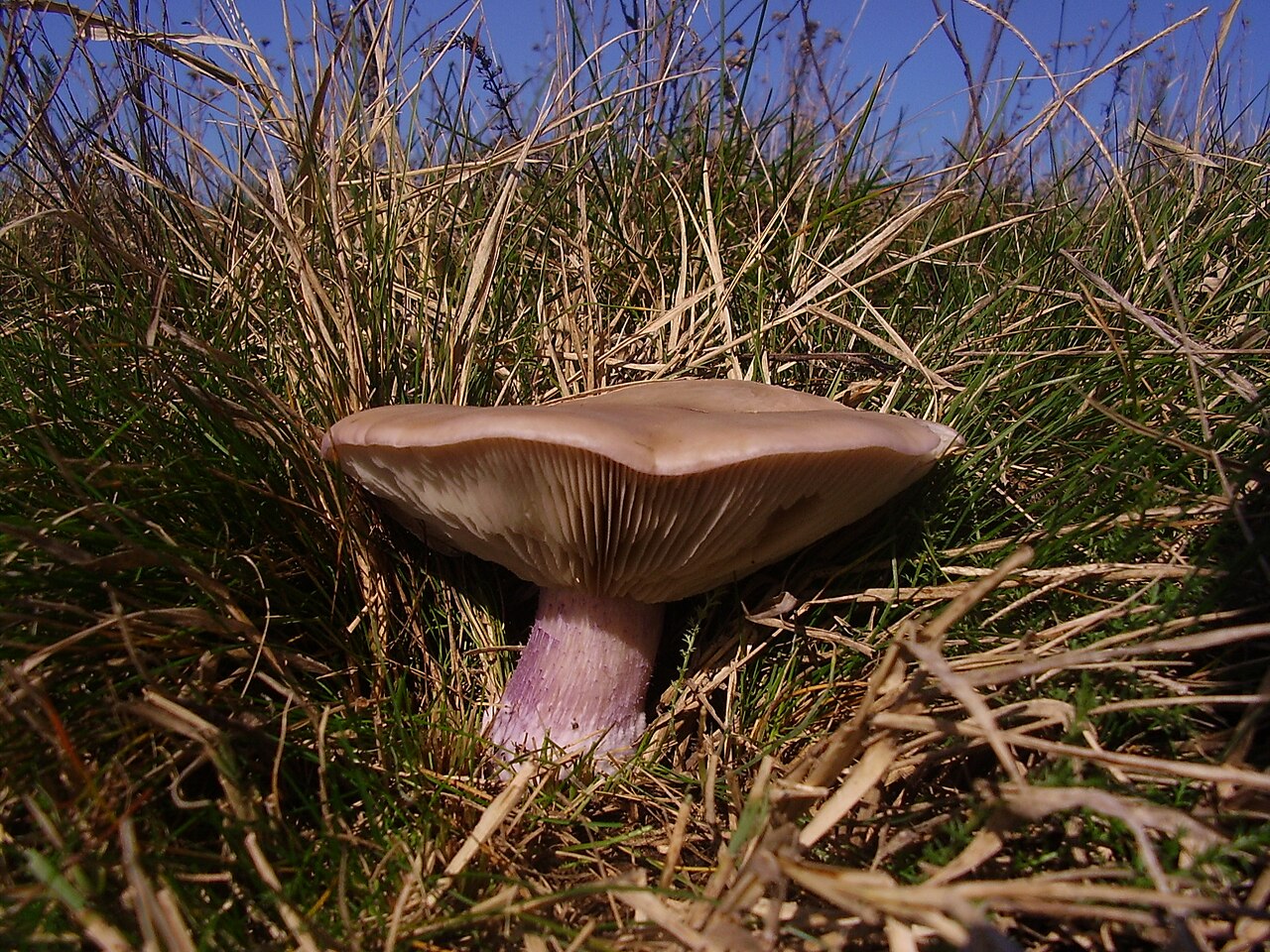
Photo: Paffka · CC BY-SA 3.0 · Photo source · License

Description
A robust grassland mushroom with a pale grey-brown cap and distinctly violet stem.
Identification features
Gills are cream to pale violet; the stem is strongly lilac, especially when young.
Identification checklist
Check the entire fruitbody for identification. A robust grassland mushroom with a pale grey-brown cap and distinctly violet stem. Gills are cream to pale violet; the stem is strongly lilac, especially when young. Typical habitat: Meadows, pasture, parks and grassy edges, often in fairy rings.
Detailed features
- Cap
- 5–16 cm, fleshy, initially hemispherical to convex, later nearly flat, very pale lilac, grey-beige to ochre.
- Hymenophore
- Gills very crowded, whitish to pale ochre or cream.
- Stem
- 6–10 × 1–3 cm, firm and solid, thickened toward the base, distinctly violet-lilac and fading with age.
- Flesh
- Whitish, dense and firm.
- Smell
- Faint to pleasant.
- Spore print
- Pale pink.
Size
- Cap diameter
- 5–16 cm
- Stem height
- 6–10 cm
- Stem diameter
- 1–3 cm
Habitat
Meadows, pasture, parks and grassy edges, often in fairy rings.
Fruiting period
September, October, November, December
Ecology
- Trophic mode
- Saprotrophic
- Substrate
- Grassland, Forest soil
- Notes
- A saprotroph of grassland, parks, woodland edges and open broadleaved habitats; it can form fairy rings.
How to separate similar species
Compare especially with these similar species: Lepista nuda, Cortinarius species. Check the combination of cap shape and colour, spore-bearing surface, stem, flesh changes and habitat. A single feature or photograph is not enough; if the key characters do not match the description, do not treat the identification as confirmed.
Similar species
- Wood blewit (Lepista nuda)
Wood blewit is usually violet on the cap and gills as well, not mainly on the stem.
- Gassy webcap (Cortinarius traganus) DANGEROUS
Some violet webcaps have a rusty-brown spore print and young specimens show cortina remnants between cap and stem.
Interesting facts
Did you know? The two-colour effect is strongest in young specimens: a pale cap above a distinctly lilac stem.