Species details
Cauliflower fungus
Sparassis crispa
Extra caution required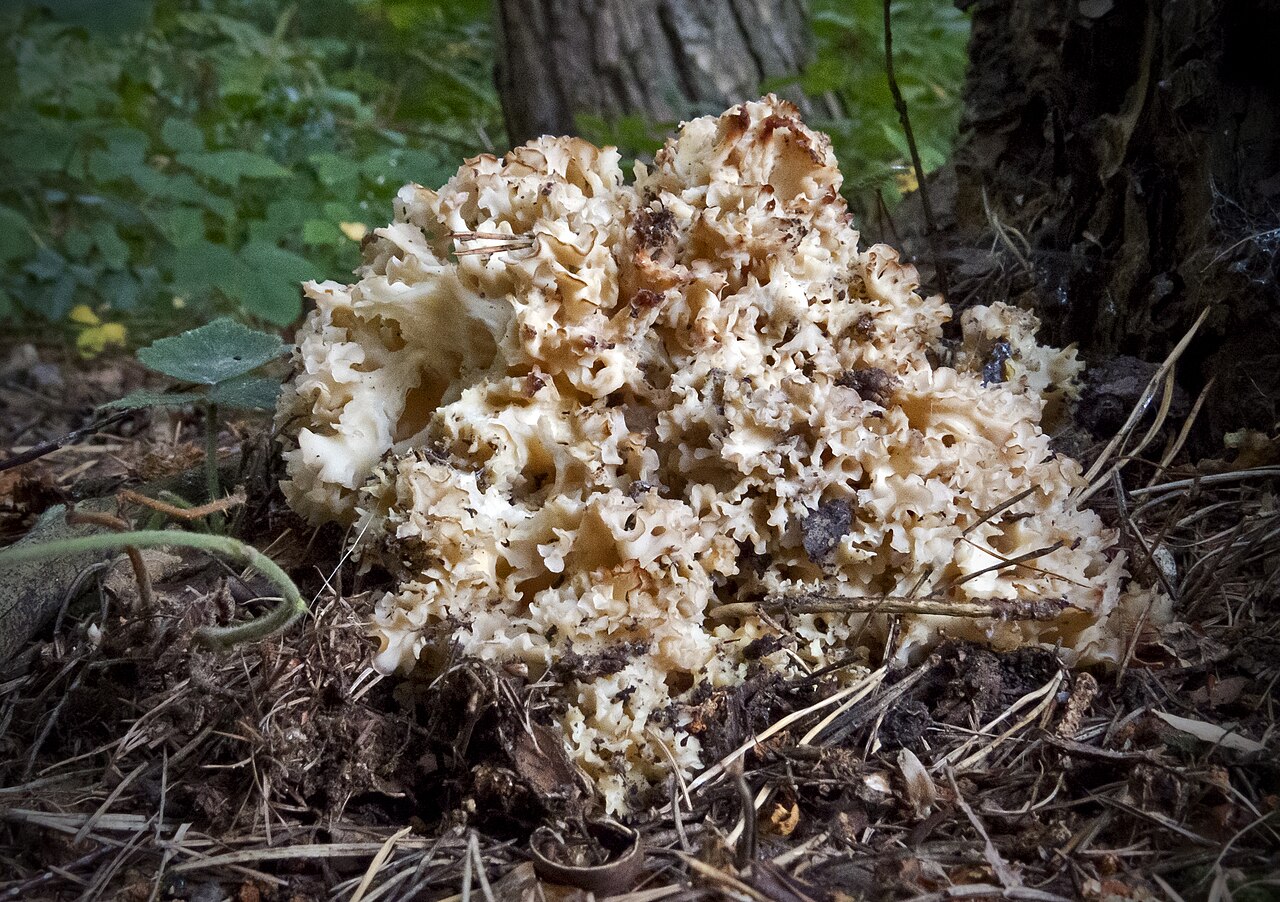
Photo: AJC1 from UK · CC BY-SA 2.0 · Photo source · License
.jpg)
Description
A large cream to ochre fruit body made of many wavy leaf-like lobes, resembling cauliflower.
Identification features
Thin curly lobes arise from a thick base; soil and needles collect inside.
Identification checklist
Check the entire fruitbody for identification. A large cream to ochre fruit body made of many wavy leaf-like lobes, resembling cauliflower. Thin curly lobes arise from a thick base; soil and needles collect inside. Typical habitat: At the base of pine, on roots or stumps, less often with other conifers.
Detailed features
- Cap
- Fruitbody 10–25, sometimes up to about 40 cm wide and tall, cauliflower-like with many strongly curled flat branches.
- Hymenophore
- The fertile surface covers the many flat branches and appears smooth.
- Stem
- The central fleshy base is about 2–8 cm thick and connects root-like to the substrate.
- Flesh
- Whitish to pale ochre, flexible and fibrous.
- Smell
- Pleasant, often nutty.
- Spore print
- Greyish white.
Habitat
At the base of pine, on roots or stumps, less often with other conifers.
Fruiting period
July, August, September, October, November
Ecology
- Trophic mode
- Parasitic
- Host trees
- Pine (Pinus)
- Substrate
- Roots, Stumps
- Notes
- A root parasite of pine, growing by trunks and roots, less often on stumps.
How to separate similar species
Compare especially with these similar species: Sparassis brevipes, Sparassis laminosa. Check the combination of cap shape and colour, spore-bearing surface, stem, flesh changes and habitat. A single feature or photograph is not enough; if the key characters do not match the description, do not treat the identification as confirmed.
Similar species
- Sparassis brevipes
Has paler, more upright, broader and less strongly curled branches; often associated with fir.
- Sparassis laminosa
Lobes are usually broader, flatter, and less tightly curled.