Species details
Blackfoot polypore
Cerioporus leptocephalus
Inedible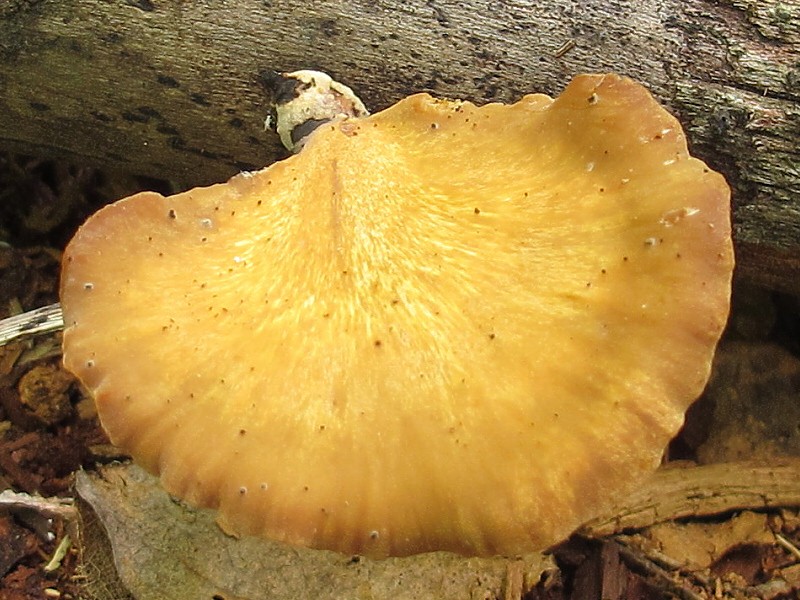
Photo: Walt Sturgeon (Mycowalt) · CC BY-SA 3.0 · Photo source · License
_Fr_229051_crop.jpg)
Description
A thin funnel- to kidney-shaped polypore on hardwood with a pale-brown cap and a characteristic dark-brown to black stem base.
Identification features
Cap about 3–10 cm, sometimes larger, hunched when young, later spread or funnel-shaped, grey-yellow to ochre-brown. Pores are small and pale; the short stem is distinctly black-brown and velvety at the base.
Identification checklist
Check the paler funnel- to kidney-shaped cap, small pores and black-brown velvety stem base.
Detailed features
- Cap
- Cap about 3–10 cm, sometimes larger, hunched when young, later spread or funnel-shaped, grey-yellow to ochre-brown.
- Hymenophore
- Pores are small and pale; the short stem is distinctly black-brown and velvety at the base.
- Stem
- Pores are small and pale; the short stem is distinctly black-brown and velvety at the base.
Size
- Cap diameter
- 3–10 cm
Habitat
Grows on trunks, branches and stumps of hardwoods, especially beech, in summer and autumn.
Fruiting period
June, July, August, September, October
Ecology
- Host trees
- Beech (Fagus)
- Substrate
- Stumps
- Notes
- Grows on trunks, branches and stumps of hardwoods, especially beech, in summer and autumn.
How to separate similar species
Picipes badius usually has a darker, glossy chestnut-brown cap. Both species have a dark stem base.
Similar species
- Black-foot polypore (Picipes badius)
- Cerioporus species
- Polyporus species