Species details
Black false bolete
Boletopsis leucomelaena
Conditional / expert preparation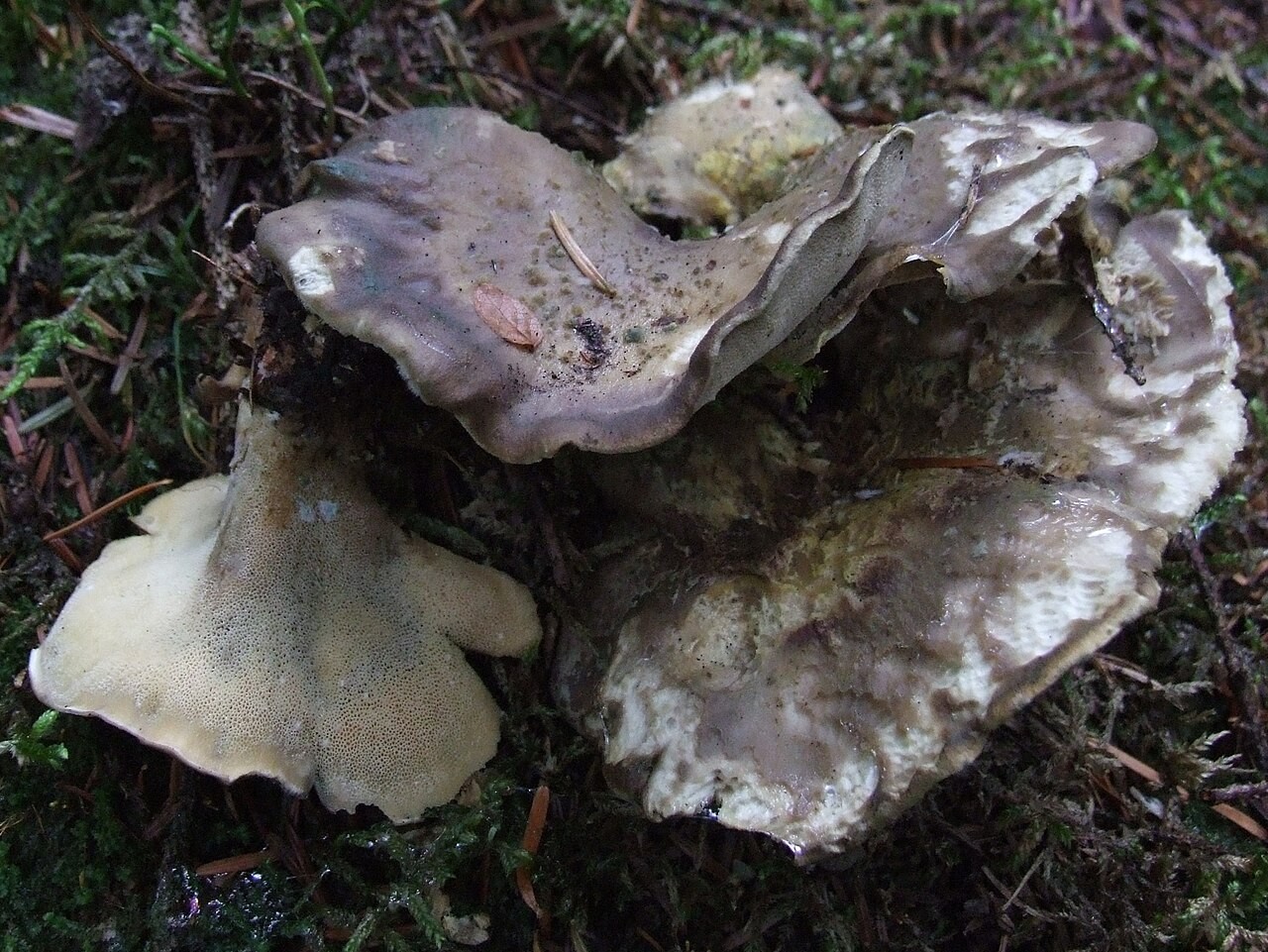
Photo: Jerzy Opioła · CC BY-SA 4.0 · Photo source · License

Description
A dark grey to almost black fleshy pore fungus with a white-to-grey pore surface, characteristic of montane conifer woodland and conservation-important.
Identification features
The cap reaches about 10 cm or more, dark grey to black-brown and often slightly scaly centrally. Pores start white and become grey. The stem is short, dark and often eccentric. White flesh turns slightly pink in air.
Identification checklist
Check the very dark cap, white-to-grey pore surface, short dark stem and slight pinking of white flesh. Photograph the species in place.
Detailed features
- Cap
- The cap reaches about 10 cm or more, dark grey to black-brown and often slightly scaly centrally.
- Hymenophore
- Pores start white and become grey.
- Stem
- The stem is short, dark and often eccentric.
- Flesh
- White flesh turns slightly pink in air.
Size
- Cap diameter
- ≤ 10 cm
Habitat
Grows in montane conifer woodland, especially with pine, on soil or needle litter, from late summer to autumn.
Fruiting period
August, September, October
Ecology
- Host trees
- Pine (Pinus)
- Notes
- Grows in montane conifer woodland, especially with pine, on soil or needle litter, from late summer to autumn.
How to separate similar species
Boletopsis grisea usually has a paler cap and its flesh does not pink in the same way. Related pore fungi can be difficult to separate without the complete fruitbody.
Similar species
- Grey false bolete (Boletopsis grisea)
- Albatrellus species
- Phellodon species
Conservation
- Red list
- R – rare species
- Notes
- On the Slovenian Red List: R – rare species.