Species details
Variegated bolete
Suillus variegatus
Conditional / expert preparation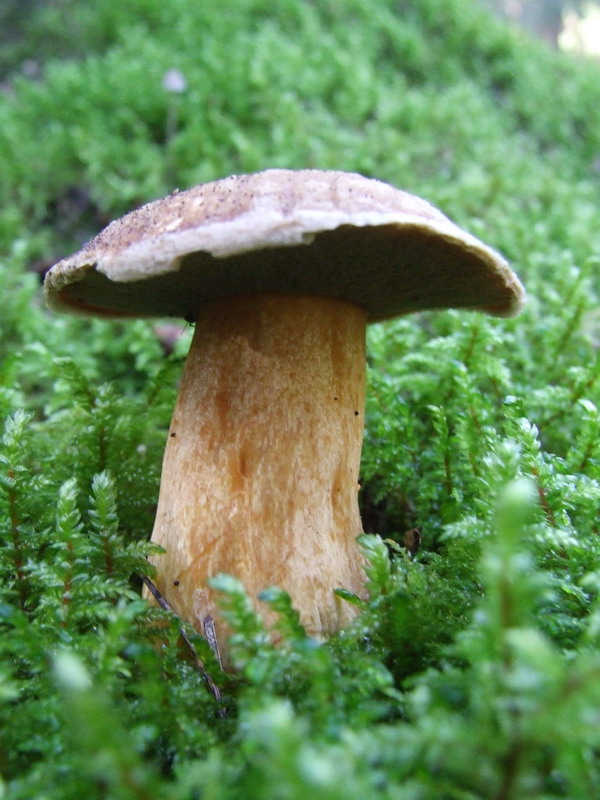
Photo: Tomas Čekanavičius · CC BY-SA 3.0 · Photo source · License

Description
A yellow to olive-brown bolete with a dry, finely scaly cap, usually with pine.
Identification features
Pores are yellow to olive and may bruise faintly blue; there is no ring.
Identification checklist
Check the entire fruitbody for identification. A yellow to olive-brown bolete with a dry, finely scaly cap, usually with pine. Pores are yellow to olive and may bruise faintly blue; there is no ring. Typical habitat: Pine woodland, often on acidic sandy soils.
Detailed features
- Cap
- 5–18 cm, hemispherical to cushion-shaped, yellow- to olive-brown, usually dry and finely granular-scaly.
- Hymenophore
- Yellow pores becoming olive-green; they may bruise slightly blue.
- Stem
- 6–10 × 2–4 cm, stout, cylindrical, yellow-brown and without a ring.
- Flesh
- Yellow; may turn bluish-green when cut.
- Smell
- May be slightly chlorine- or resin-like.
- Spore print
- Olive-brown.
Size
- Cap diameter
- 5–18 cm
- Stem height
- 6–10 cm
- Stem diameter
- 2–4 cm
Habitat
Pine woodland, often on acidic sandy soils.
Fruiting period
July, August, September, October, November
Ecology
- Trophic mode
- Mycorrhizal
- Host trees
- Pine (Pinus)
- Substrate
- Forest soil
- Soil
- Acidic, Sandy
- Notes
- Mycorrhizal with pines; common in pine woodland on nutrient-poor, acidic and sandy soils.
How to separate similar species
Compare especially with these similar species: Suillus bovinus, Suillus luteus. Check the combination of cap shape and colour, spore-bearing surface, stem, flesh changes and habitat. A single feature or photograph is not enough; if the key characters do not match the description, do not treat the identification as confirmed.
Similar species
- Jersey cow mushroom (Suillus bovinus)
Bovine bolete has a smoother, stickier cap when wet and much broader angular pores.
- Slippery jack (Suillus luteus)
Slippery jack has a strongly slimy cap and a well-developed ring on the stem.
Interesting facts
Did you know? It is one of the larger Suillus species, and its cap is usually drier than in many other members of the genus.