Species details
Suede bolete
Xerocomus subtomentosus
Extra caution required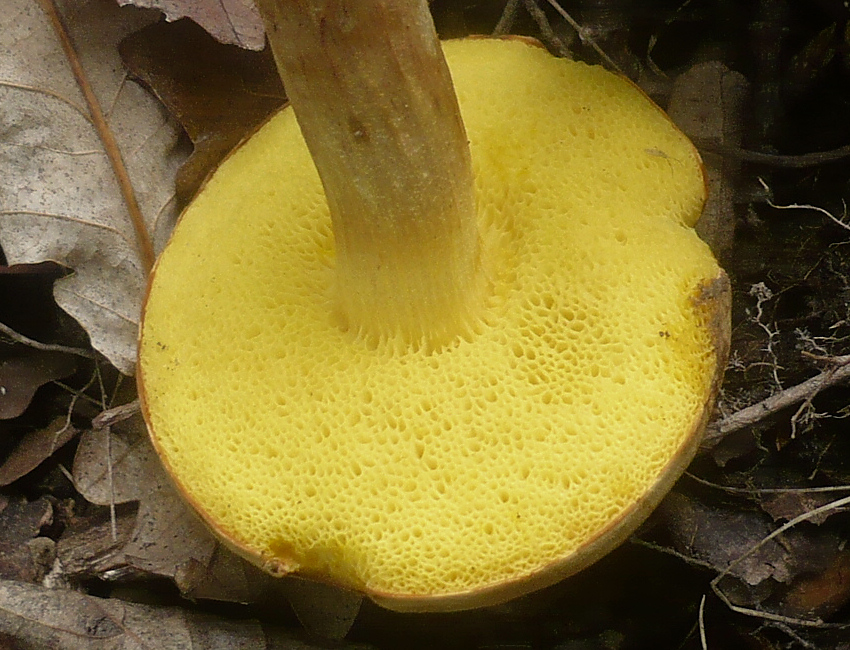
Photo: Gerhard Koller · CC BY-SA 3.0 · Photo source · License
_Fr_228139_crop2.jpg)
Description
An olive to yellow-brown bolete with a velvety cap and large yellow pores.
Identification features
The stem is yellowish and often longitudinally ribbed; pale flesh blues only weakly.
Identification checklist
Check the entire fruitbody for identification. An olive to yellow-brown bolete with a velvety cap and large yellow pores. The stem is yellowish and often longitudinally ribbed; pale flesh blues only weakly. Typical habitat: Deciduous and mixed woodland, especially with oak and beech.
Detailed features
- Cap
- 5–10 cm, felted, olive-brown to greenish or yellow-brown.
- Hymenophore
- Initially yellow, later olive-brown pores; may turn greenish when bruised.
- Stem
- 5–8 × 1–2 cm, usually cylindrical, yellow to brownish, often longitudinally streaked.
- Flesh
- White to yellowish; becomes soft with age.
- Smell
- Pleasant.
- Spore print
- Yellowish olive-brown.
Size
- Cap diameter
- 5–10 cm
- Stem height
- 5–8 cm
- Stem diameter
- 1–2 cm
Habitat
Deciduous and mixed woodland, especially with oak and beech.
Fruiting period
June, July, August, September, October, November
Ecology
- Trophic mode
- Mycorrhizal
- Host trees
- Spruce (Picea), Beech (Fagus), Oak (Quercus)
- Substrate
- Forest soil
- Notes
- Occurs as a mycorrhizal species in deciduous and coniferous woodland.
How to separate similar species
Compare especially with these similar species: Xerocomus ferrugineus, Xerocomellus chrysenteron, Hortiboletus bubalinus. Check the combination of cap shape and colour, spore-bearing surface, stem, flesh changes and habitat. A single feature or photograph is not enough; if the key characters do not match the description, do not treat the identification as confirmed.
Similar species
- Xerocomus ferrugineus
Often has a browner, faintly reticulate stem and yellowish basal mycelium.
- Red-cracking bolete (Xerocomellus chrysenteron)
The cap often cracks to reveal reddish tissue, and the lower stem may be red.
- Rheubarbariboletus armeniacus
Usually shows stronger apricot to orange-red tones on cap and stem.