Species details
Fluted bird’s nest
Cyathus striatus
Inedible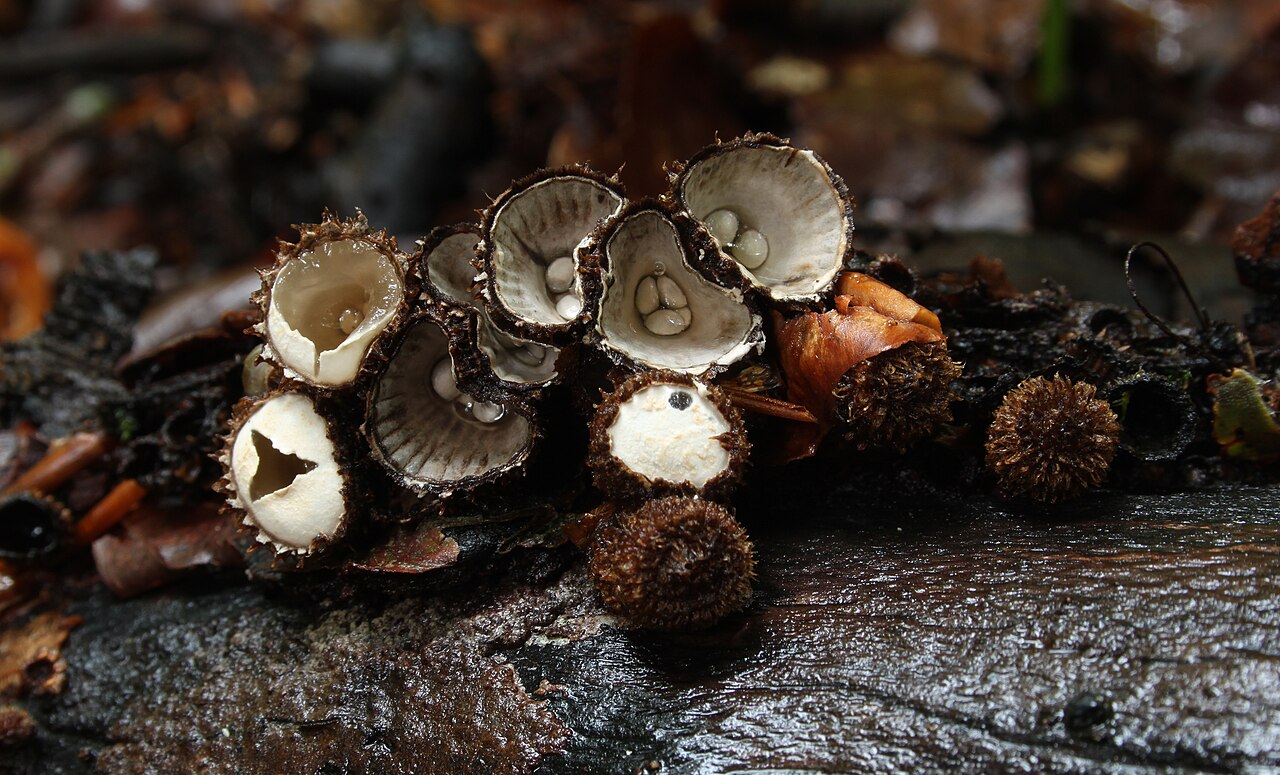
Photo: Holger Krisp · CC BY 3.0 · Photo source · License

Description
A tiny bird’s-nest fungus with a longitudinally fluted inner wall and small spore-containing “eggs”.
Identification features
The fruitbody is initially closed by a whitish membrane and later opens into a cup. It is dark brown and hairy outside, shiny grey and clearly fluted inside, with no stem.
Identification checklist
Check the entire fruitbody for identification. A tiny bird’s-nest fungus with a longitudinally fluted inner wall and small spore-containing “eggs”. The fruitbody is initially closed by a whitish membrane and later opens into a cup. It is dark brown and hairy outside, shiny grey and clearly fluted inside, with no stem. On decaying wood, leaf litter and other plant debris; possible throughout the year.
Detailed features
- Cap
- A tiny bird's-nest-like cup with a longitudinally grooved inner wall and small spore-bearing 'eggs'.
- Hymenophore
- The fruitbody is initially closed by a whitish membrane and later opens into a cup. It is dark brown and hairy outside, glossy grey and distinctly grooved inside, with no stem.
- Flesh
- White and somewhat tough.
- Smell
- No distinctive smell.
- Spore print
- White.
Habitat
On decaying wood, leaf litter and other plant debris; possible throughout the year.
Fruiting period
January, February, March, April, May, June, July, August, September, October, November, December
Ecology
- Trophic mode
- Saprotrophic
- Substrate
- Dead wood, Leaf litter
- Notes
- Saprotrophic species. On decaying wood, leaf litter and other plant debris; possible throughout the year.
How to separate similar species
Compare especially with: Cyathus olla, Cyathus stercoreus. A single feature or photograph is not sufficient for reliable identification.
Similar species
- Field bird's nest (Cyathus olla)
C. striatus has a distinctly longitudinally striated inner cup wall; C. olla is much smoother inside.
- Cyathus stercoreus
Interesting facts
Did you know? Raindrops splash the spore-bearing 'eggs' out of the cup, a characteristic bird's-nest fungus mechanism.