Species details
Beautiful coral fungus
Ramaria formosa
Poisonous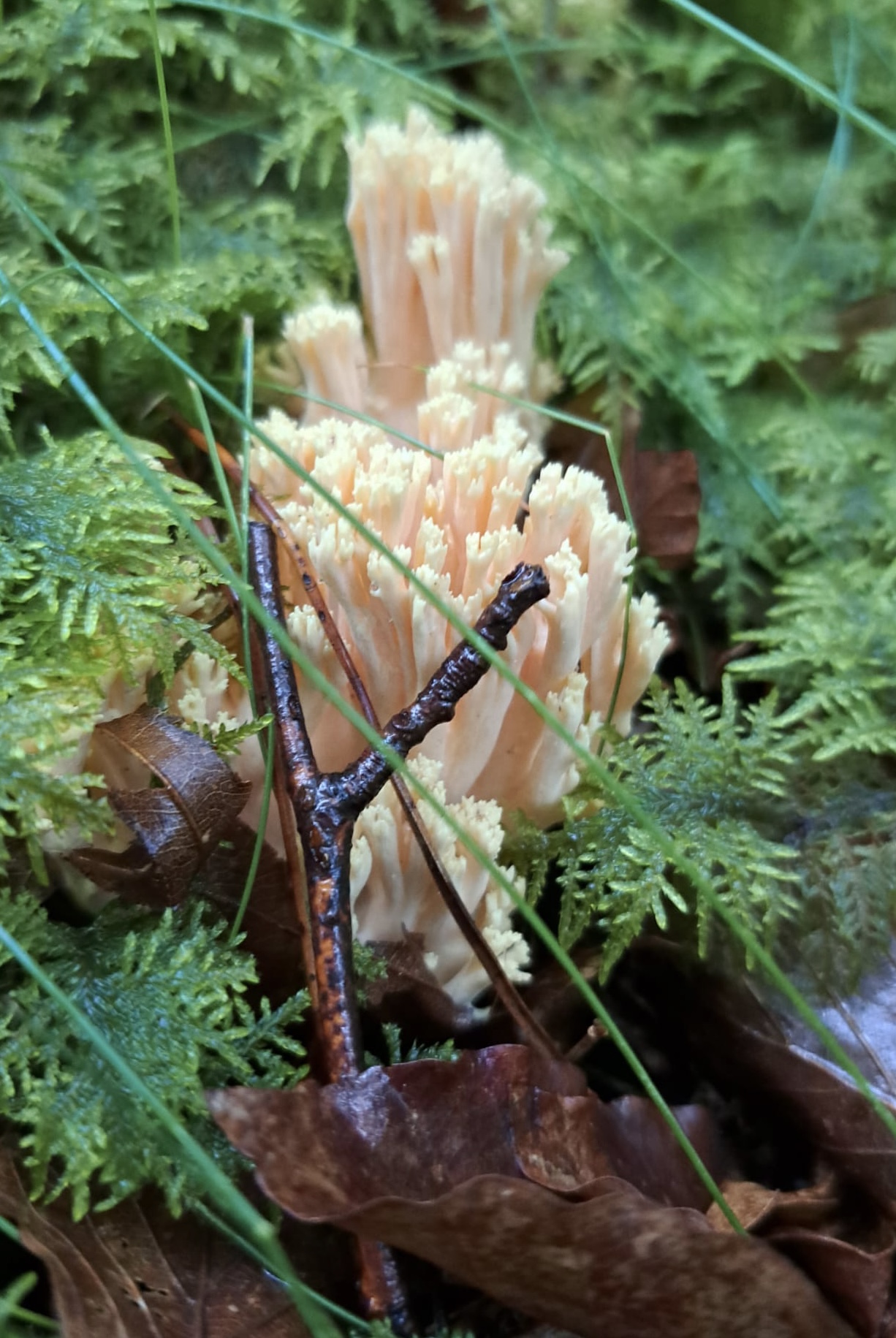
Photo: Jose Angel Urquia Goitia · CC BY-SA 4.0 · Photo source · License

Description
A large branched coral fungus with pink-orange branches and yellowish tips.
Identification features
Colours fade with age; consumption can cause strong gastrointestinal upset and a purgative effect.
Identification checklist
Check the entire fruitbody for identification. A large branched coral fungus with pink-orange branches and yellowish tips. Colours fade with age; consumption can cause strong gastrointestinal upset and a purgative effect. Typical habitat: Deciduous and mixed woodland, often with beech on richer soils.
Detailed features
- Cap
- 7–30 cm high and up to about 15 cm wide, coral-branched; white base, pink to orange-pink branches and lemon-yellow tips.
- Hymenophore
- The fertile layer covers the outer branches and branchlets; spore print is ochre.
- Stem
- 3–6 cm high and 2.5–6 cm thick, white and stout, then strongly branching.
- Flesh
- White, sometimes becoming pink-brown when cut.
- Smell
- No distinctive smell.
- Spore print
- Ochre.
Size
- Stem height
- 3–6 cm
- Stem diameter
- 2,5–6 cm
Habitat
Deciduous and mixed woodland, often with beech on richer soils.
Fruiting period
July, August, September, October
Ecology
- Trophic mode
- Mycorrhizal
- Substrate
- Forest soil
- Notes
- A mycorrhizal species, most often in broadleaved and mixed woodland from summer to late autumn.
How to separate similar species
Compare especially with these similar species: Ramaria botrytis, Ramaria flavescens. Check the combination of cap shape and colour, spore-bearing surface, stem, flesh changes and habitat. A single feature or photograph is not enough; if the key characters do not match the description, do not treat the identification as confirmed.
Similar species
- Ramaria flava
Yellow coral is more uniformly yellow; R. formosa characteristically grades from a white base through pink-orange branches to yellow tips.
- Golden coral fungus (Ramaria aurea)
Golden coral is usually more uniformly golden-yellow without the strong three-colour pattern; old coral fungi can be very difficult to identify.
Interesting facts
Did you know? The characteristic three-colour pattern is most useful in young fruitbodies; the colours fade strongly with age.